
African Forest Elephant
Scientific name Loxodonta cyclotis
Adult size
- Weight
- ♀F 2200 kg ♂M 3200 kg
- Length
- ♀F 4 m ♂M 4.5 m
- Shoulder height
- ♀F 2.2 m ♂M 2.4 m
- Top speed
- ♀F 40 km/h ♂M 40 km/h
- Lifespan
- Exact African Forest Elephant records are sparse, but wider African-elephant data point to about 65-70 years in the wild.
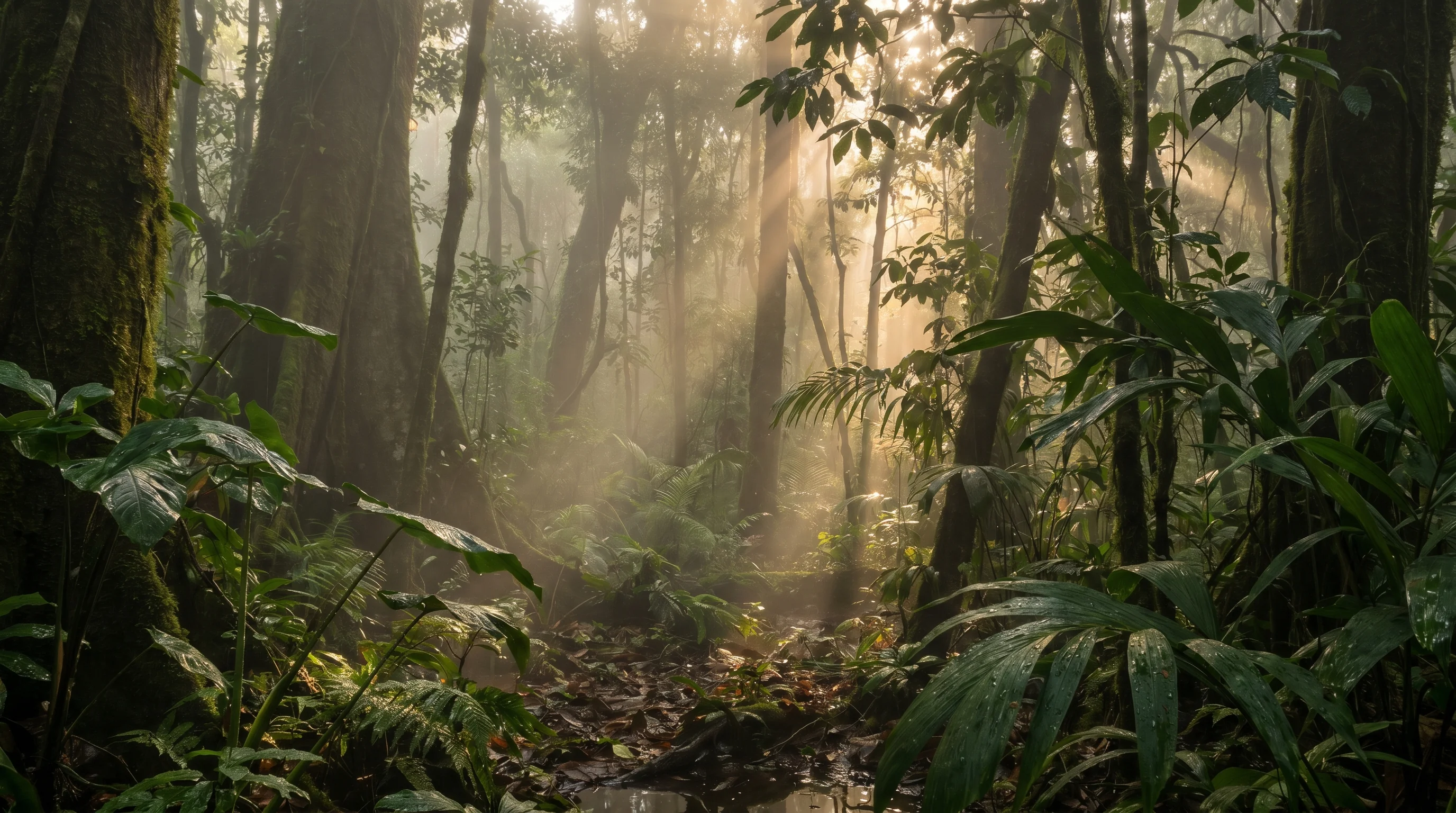
African forest elephants live in Central and West African rainforest, with their strongest homes in the Congo Basin: Republic of Congo, Gabon, Cameroon, Central African Republic, and Democratic Republic of the Congo, plus smaller remnant populations in places such as Cote d'Ivoire, Liberia, Ghana, and Sierra Leone. Their world is closed-canopy forest, swamp, floodplain, and mineral-rich clearings called bais, where the same individuals return year after year.
The range
Four regions, one species.
The african forest elephant doesn't live in one place. Across the map below, each region has its own pressures, prey, and politics — same biology, different worlds.
-
Republic of Congo
Nouabalé-Ndoki National Park
Mbeli Bai sympatry with Western Lowland Gorilla (Mokonzi home range). Daily bai co-occurrence documented across multi-decade WCS research, which makes this a useful natural-rival context for Mokonzi.
Source ↗ -
Gabon
Lopé National Park
Long-term forest-elephant behavioural research site; Wildlife Conservation Society-affiliated.
Source ↗ -
Gabon
Ivindo National Park
Langoué Bai — one of the most-studied forest-elephant bai aggregation sites in the Congo Basin.
Source ↗ -
Central African Republic
Dzanga-Ndoki National Park
Dzanga Bai — canonical forest-elephant aggregation site; highest concentrations of forest elephants in Africa recorded here during peak dry-season bai visits.
Source ↗
Daily life
What the african forest elephant does, day to day.
Diet, social behaviour, climate — the everyday biology that shapes how this species hunts, defends and survives.
-
Diet
Frugivore-folivore. Central African forest elephants are mega-frugivores — over 100 fruit species recorded in their diet, with fruit consumption rates dwarfing those of any other African large mammal.
-
Social life
Matriarchal family groups of typically 3-8 individuals — substantially smaller than savanna elephant herds — linked to larger clan networks at bai gatherings.
-
Climate
Central African tropical rainforest — Congo Basin, Gabonese and Cameroonian forests, Sangha River basin.
Wyld Trivia
Five questions. Most people get them wrong.
But you're not most people.
Tap to reveal.
-
How can DNA show that two huge animals are different species?
Show me HideUntil 2010, scientists weren't sure: were Africa's forest and savanna elephants two species or one? Then a big DNA study compared their genomes side by side. The differences ran deep — deeper than scientists expected. The forest elephant (Loxodonta cyclotis) and the savanna elephant (Loxodonta africana) are now treated as two separate species, not two kinds of one. They can sometimes hybridise, but their genomes have been on different paths for millions of years.
-
What's the safest way to compare a forest elephant with a savanna elephant?
Show me HideBy the numbers. A 2003 field study in Gabon measured forest elephants using photographs, footprints and dung — and compared them to savanna elephants in Kenya. Forest elephants were clearly smaller at the shoulder, age for age. That's a real, measured size difference. But why they ended up smaller is harder to prove. Don't trust 'evolved to walk through forests' stories unless a paper has actually tested that idea.
-
Can a seed's best trip through a forest start inside an elephant?
Show me HideSometimes — yes. In a Ghana rainforest, scientists found seeds of named trees like Panda oleosa, Balanites wilsoniana and Strychnos aculeata in forest elephant dung. They tested whether the swallowed seeds sprouted better than fresh seeds. For three of the tested species, gut-passage seeds germinated better. So forest elephants don't just move seeds — for some plants, they help more of them grow.
-
Why would elephants keep returning to the same forest clearing?
Show me HideAt Dzanga Bai in the Central African Republic, scientists watched the same forest elephants come back year after year — often alone or in small groups, not always big herds. Adult males arrived solo most of the time. Female groups were usually small. Bais are mineral-rich clearings in dense rainforest, and the same individuals visit repeatedly. They're regular gathering places — but only one part of a forest elephant's life.
-
How do scientists count elephants in forests where they're hard to see?
Show me HideBy their dung. Forest elephants are nearly invisible in dense rainforest, so scientists walk hundreds of straight-line transects and count dung piles instead. A 2013 Central African survey using this method found forest elephants dropped sharply between 2002 and 2011 — about 62% across much of their range. They're now classified Critically Endangered. Counting elephants you can't see is hard. The dung tells the truth.
The terrain
Where the african forest elephant thrives.
Every animal is built for some places more than others. These are the ground, hours and weather where this species shows its best — and its worst.
Ground
- Rainforest Excels
- Bai clearing Excels
- Swamp Strong
- Floodplain Strong
- Mountain forest Average
- Savanna Struggles
- Desert Avoids
Hours
- Dawn Excels
- Dusk Excels
- Twilight Excels
- Day Strong
- Night Strong
Weather
- Moderate Excels
- Rain Excels
- Hot Strong
- Wind Average
- Storm Struggles
- Cold Avoids
Five things you didn't know about the african forest elephant.
Cited biology that shapes how the african forest elephant feeds, defends, survives.
-
Forest elephants (Loxodonta cyclotis) and savanna elephants (Loxodonta africana) were formally recognised as separate species in 2021 following Rohland et al.'s 2010 PLOS Biology genome-wide analysis. The two lineages diverged 2-7 million years ago — a divergence comparable to that between Asian elephants and woolly mammoths. Forest elephants are smaller, with straighter downward-pointing tusks and rounder ears. Source ↗
-
Forest elephants are clearly smaller than savanna elephants. Morgan & Lee's 2003 Gabon field study used photographs, footprints, and dung to measure forest elephants and compared them to savanna elephants in Kenya — forest elephants were measurably shorter at the shoulder, age for age. Adult males average 2.4 m at the shoulder and 2-4 tonnes versus 3+ m and 4-7 tonnes for savanna elephants. Source ↗
-
Forest elephants are mega-frugivores — over 100 fruit species recorded in their diet. Lieberman, Lieberman & Martin's 1987 Biotropica study identified 449 seeds across 11 species in forest-elephant dung at Bia National Park, Ghana, with Panda oleosa, Balanites wilsoniana, Strychnos aculeata, and Parinari excelsa the most-represented species. For three of the species tested, ingested seeds germinated significantly better than fresh seeds — direct evidence the species is a keystone disperser for large-seeded tropical trees. Source ↗
-
Forest clearings called 'bais' are mineral-rich gathering points where forest elephants congregate. Fishlock & Lee's 2014 study at Dzanga Bai in the Central African Republic tracked the same individuals returning year after year — adult males usually solo, female groups small. Bais are not just food sources; they're long-term social hubs that host repeat individual visits across decades. Source ↗
-
Forest elephant populations across Central Africa declined by approximately 62% between 2002 and 2011, measured by dung-count transect surveys. The IUCN uplisted the species from Vulnerable to Critically Endangered in 2021 after a roughly 86% population decline over 31 years from poaching for ivory and habitat loss. Among the most threatened African large mammals. Source ↗
About the african forest elephant
Where the african forest elephant sits on the tree of life.
-
Class
Mammalia
Warm-blooded animals with fur or hair that feed their young milk.
-
Order
Proboscidea
A group of related families — Proboscidea.
-
Family
Elephantidae
A family of related species — Elephantidae.
-
Species
Loxodonta cyclotis
African Forest Elephant — the species this page is about.


