
Southern Cassowary
Scientific name Casuarius casuarius
Adult size
- Weight
- ♀F 65 kg ♂M 40 kg
- Length
- ♀F 1.4 m ♂M 1.2 m
- Standing height
- ♀F 1.65 m ♂M 1.55 m
- Top speed sprint
- ♂M 50 km/h
- Lifespan
- Southern Cassowaries can live about 18-20 years in the wild, and 20-40 years in captivity.
Represented by Muruk Daintree National Park, Australia

Southern cassowaries live in tropical rainforest in far north Queensland, New Guinea, and a few Indonesian island populations including Seram and the Aru Islands. In Australia their best-known strongholds are the Wet Tropics, Daintree, Cape York's Iron Range, and lowland rainforest where fruit falls thick under the canopy. New Guinea holds the larger share of the global population.
Where they live
Three angles, one home.
The southern cassowary represented in the Wyld Savage League lives in Daintree National Park, Australia. Three views of the same patch of country — at ground level, from above, and bird's-eye.
-
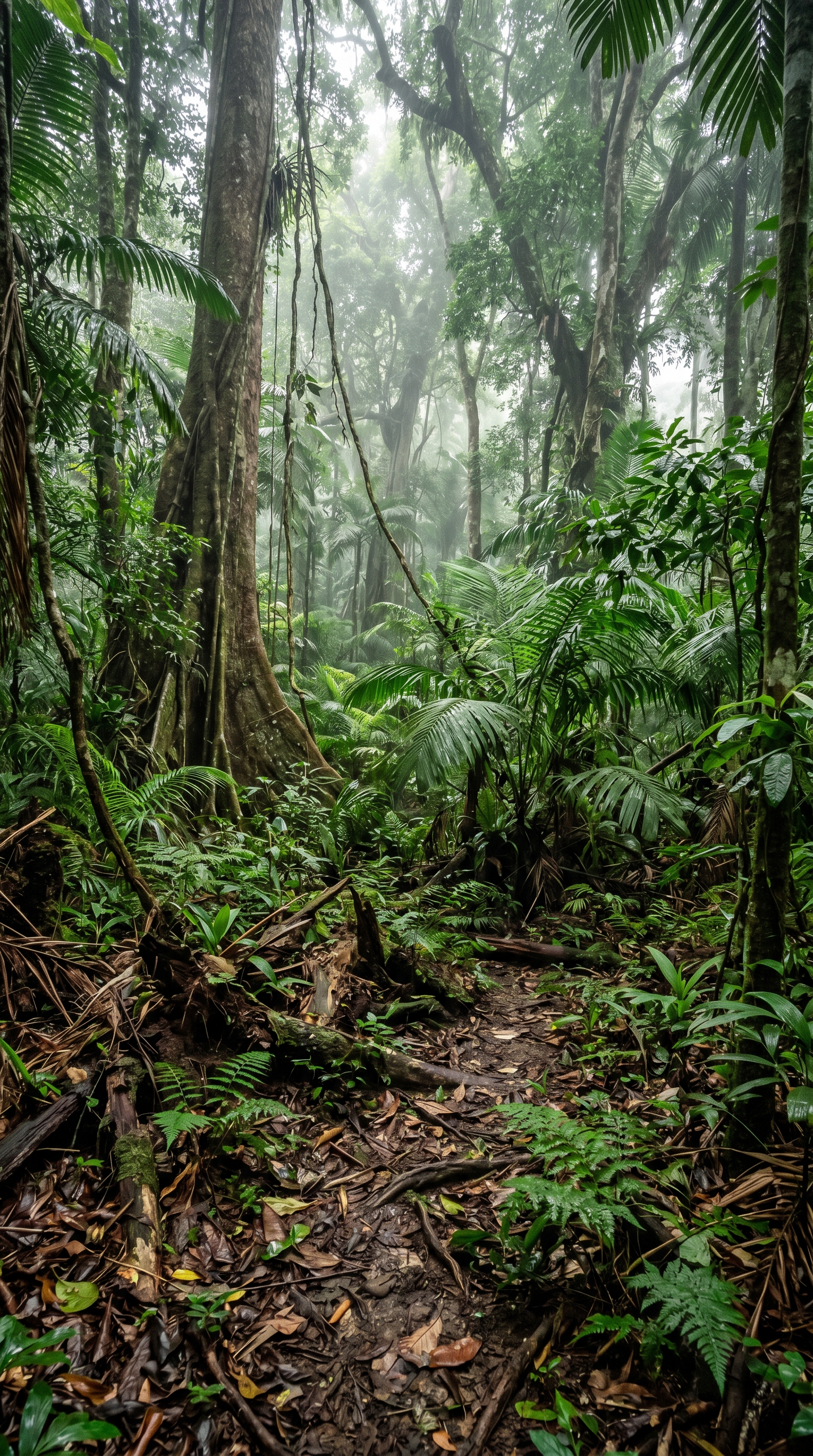
Daintree National Park, Australia at ground level — home of the southern cassowary. -
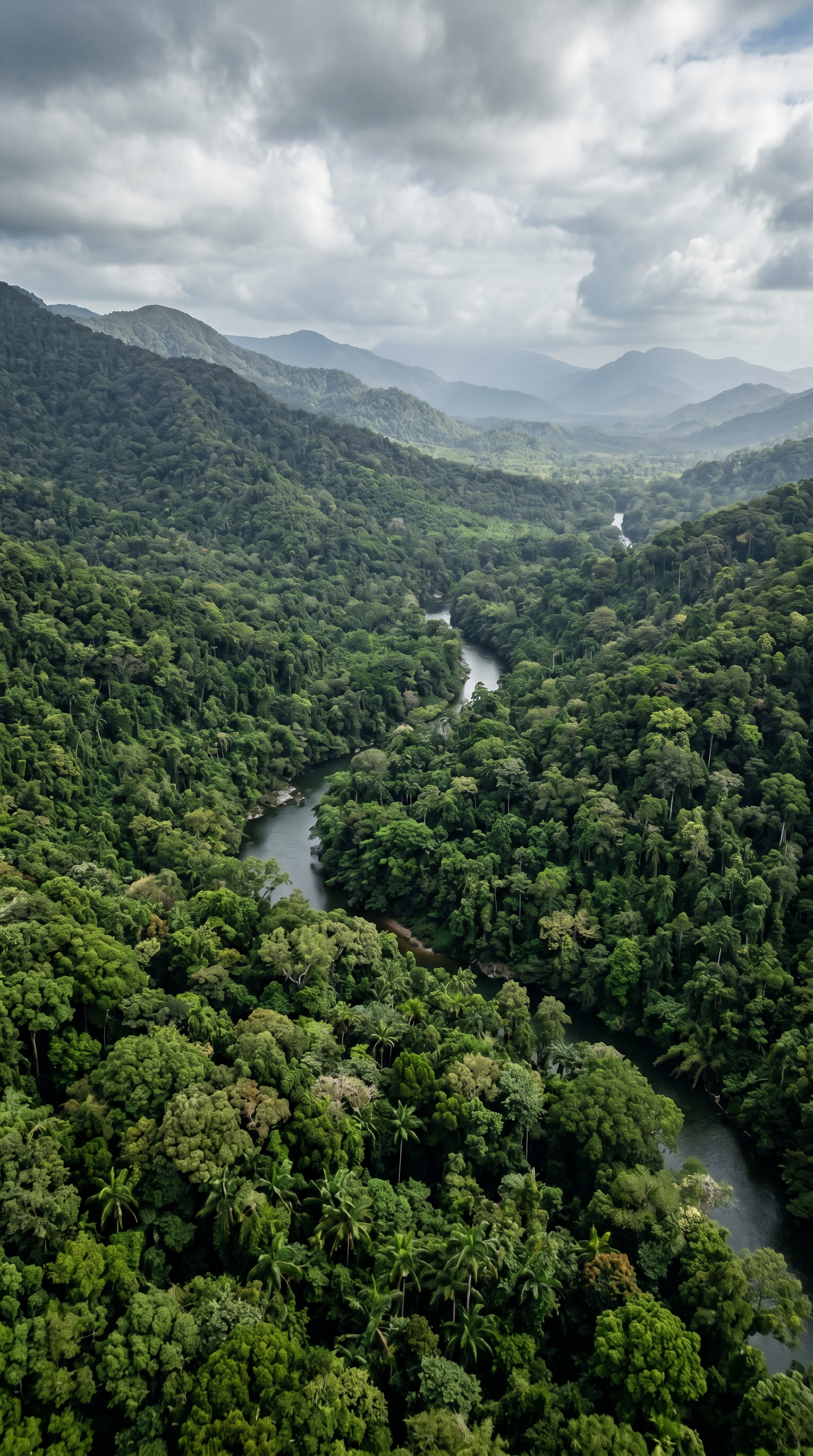
Daintree National Park, Australia seen from above — home of the southern cassowary. -
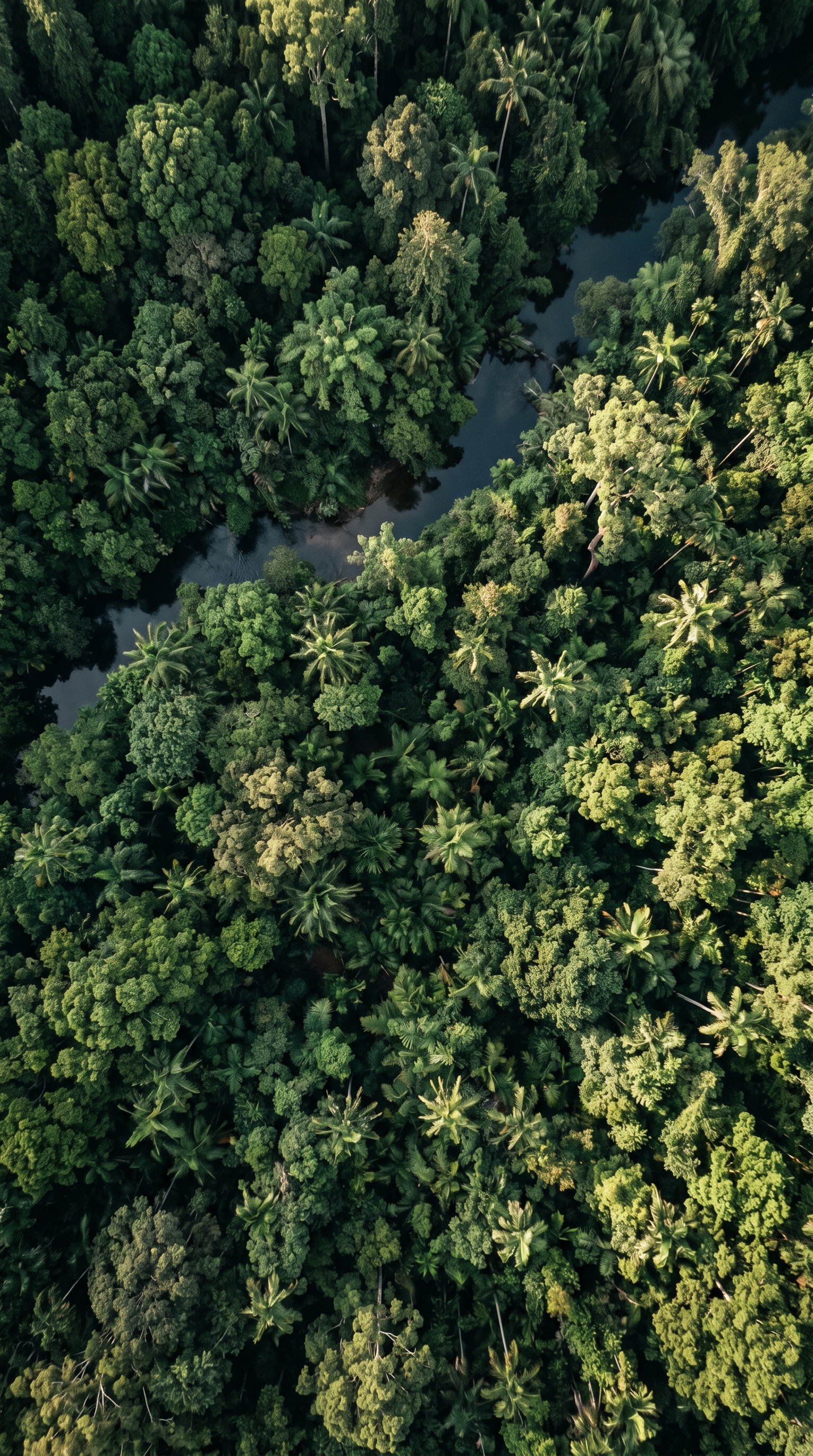
Daintree National Park, Australia from high overhead — home of the southern cassowary.
Native range
Southern cassowaries live in tropical rainforest in far north Queensland, New Guinea, and a few Indonesian island populations including Seram and the Aru Islands. In Australia their best-known strongholds are the Wet Tropics, Daintree, Cape York's Iron Range, and lowland rainforest where fruit falls thick under the canopy. New Guinea holds the larger share of the global population.
The range
Five regions, one species.
The southern cassowary doesn't live in one place. Across the map below, each region has its own pressures, prey, and politics — same biology, different worlds.
-
Australia
Daintree National Park
Lowland tropical rainforest stronghold in the Wet Tropics of Queensland; Muruk home territory (Group G4, Session 10). Sympatric with saltwater crocodile (*Crocodylus porosus*) at lowland river crossings during the wet season — documented predation mortality per Queensland Cassowary Recovery Plan and DCCEEW EPBC Significant Impact Guidelines. Range-string normalised to bare 'Daintree National Park' (Bialowieza precedent) for validator Rule 1 exact-match with saltwater-crocodile.md.
Source ↗ -
Australia
Wet Tropics of Queensland World Heritage Area
Core Australian population; EPBC-listed Endangered; estimated 1,500–2,500 adults across the subspecies.
Source ↗ -
Australia
Iron Range National Park (Cape York Peninsula)
Cape York population — Vulnerable under Queensland's Nature Conservation Act 1992.
Source ↗ -
Indonesia
Lorentz National Park (Papua, New Guinea)
Largest contiguous lowland-rainforest protected area on New Guinea; species stronghold.
Source ↗ -
Indonesia
Seram (Maluku)
Island subpopulation; distribution may reflect historical human translocation.
Source ↗
Daily life
What the southern cassowary does, day to day.
Diet, social behaviour, climate — the everyday biology that shapes how this species hunts, defends and survives.
-
Diet
Primarily frugivorous. Consumes fallen canopy fruits from hundreds of rainforest tree species — including Davidsonia pruriens and members of the laurel family — supplemented by fungi, insects, small vertebrates, and carrion.
-
Social life
Solitary and territorial year-round outside the brief breeding season.
-
Climate
Tropical and subtropical rainforest. Prefers high humidity, dense lowland evergreen forest typically below 1,100 m elevation, and permanent water access.
Wyld Trivia
Five questions. Most people get them wrong.
But you're not most people.
Tap to reveal.
-
Is the cassowary really the world's most dangerous bird?
Show me HideCassowaries have a fierce reputation, but the peer-reviewed evidence is more nuanced. A 1999 Queensland study of 221 attacks found that 75% of human-directed incidents involved birds that had been fed by people. Within the scientific record only one human death is documented, and the victim was trying to kill the bird. The inner toe carries a long sharp claw that can cause deep injuries, so serious injury is possible, but verified attacks on people are rare and usually linked to feeding.
-
What's in a cassowary's poo that makes it the rainforest's most important gardener?
Show me HideSeeds — lots of them. A single dung pile can hold up to 1 kilogram of seeds and fruit fragments. Scientists found seeds from 78 different rainforest plant species in cassowary dung, and germination tests showed seedlings could sprout from 70 of those species. No other animal in the Australian rainforest spreads as many seeds — losing cassowaries would mean losing whole tree species.
-
Which cassowary parent does ALL the work raising chicks?
Show me HideThe dad. Female cassowaries lay the eggs and walk away — they may even mate with more than one male in a year. The male alone sits on the eggs until they hatch, then protects and feeds the chicks until they are old enough to leave. Females and males never raise a brood together.
-
What does a cassowary's helmet actually do?
Show me HideIt works like a radiator. The 'casque' is a hollow, helmet-shaped structure on top of the head, made of keratin over bone. Scientists used heat cameras on 20 live cassowaries and showed the casque helps the bird dump heat when it's hot and hold heat when it's cool — about 8% of how the bird manages its body temperature. The popular idea that the casque is a battering ram for smashing through forest is NOT supported by the modern anatomy research.
-
Why does a cassowary's call feel like a vibration you can almost feel?
Show me HideTheir booming call is at the very low end of sounds — far lower than most bird calls — so it travels through dense rainforest where higher-pitched sounds get absorbed by leaves and trunks. The deep boom is the cassowary's way of reaching another bird hundreds of metres away through forest you cannot see through.
The terrain
Where the southern cassowary thrives.
Every animal is built for some places more than others. These are the ground, hours and weather where this species shows its best — and its worst.
Ground
- Tropical rainforest Excels
- Mangrove forest Strong
- Swamp forest Strong
- Forest edge Average
- Open grassland Avoids
- Alpine Avoids
Hours
- Dawn Excels
- Dusk Excels
- Day Strong
- Twilight Strong
- Night Struggles
Weather
- Moderate Excels
- Rain Excels
- Hot Strong
- Wind Average
- Storm Struggles
- Cold Avoids

Five things you didn't know about the southern cassowary.
Cited biology that shapes how the southern cassowary feeds, defends, survives.
-
The Southern Cassowary has a fierce reputation, but a peer-reviewed Queensland review of 221 attacks, including 150 on people, found that 75% of human-directed incidents involved birds that had been fed by people. Within that scientific record only one human death is documented, and the victim was trying to kill the bird. The inner toe carries a long sharp claw that can cause deep puncture injuries and lacerations, but serious injury from a wild cassowary is described as rare in the peer-reviewed literature. Source ↗
-
A single cassowary dropping can hold up to 1 kg of seeds and fruit fragments. Researchers found diaspores from 78 plant species in cassowary dung, with germination observed in tests for 70 of those species — making the southern cassowary the most important seed disperser in Australia's tropical rainforest and the sole disperser for many large-seeded trees. Source ↗
-
The cassowary's casque (the bony, keratin-sheathed helmet atop its skull) functions as a thermal window: infrared thermography across 20 live birds showed the uninsulated, highly vascularised casque acts as a heat radiator — offloading heat at high ambient temperatures and restricting heat loss at low ones — accounting for roughly 8% of total body heat exchange. Source ↗
-
Cassowaries are ratites — the lineage of flightless birds that also includes ostriches, emus, rheas, and kiwis. A Southern Cassowary can crash through tangled rainforest at speed when alarmed, smashing aside vegetation that would slow most other animals down. Source ↗
-
Southern Cassowary parental investment is reversed: females lay the clutch and walk away, and the male alone incubates the eggs and then raises the chicks. Females may mate with more than one male in a year while the father does all the egg-sitting and chick-rearing. Source ↗
About the southern cassowary
Where the southern cassowary sits on the tree of life.
-
Class
Aves
Birds — warm-blooded, feathered, and (mostly) able to fly.
-
Order
Casuariiformes
Big flightless birds from Australia and New Guinea — cassowaries and emus.
-
Family
Casuariidae
The cassowaries — heavy flightless rainforest birds.
-
Species
Casuarius casuarius
Southern Cassowary — the species this page is about.


