
Spotted Hyena
Scientific name Crocuta crocuta
Adult size
- Weight
- ♀F 63 kg ♂M 53 kg
- Length
- ♀F 1.3 m ♂M 1.3 m
- Shoulder height
- ♀F 0.82 m ♂M 0.8 m
- Top speed chase
- ♀F 60 km/h ♂M 60 km/h
- Lifespan
- Spotted Hyenas can live about 20 years in the wild; captive records can reach about 41 years.
Represented by Phiri The Okavango Delta, Botswana

Spotted hyenas live across much of sub-Saharan Africa, from East African grasslands to Southern African savanna, open woodland, semi-desert, and some mountain country. Their strongest landscapes include the Serengeti-Mara ecosystem, Ngorongoro Crater, Okavango Delta, Kruger, and other places where large herds of wildebeest, zebra, antelope, and buffalo keep the food chain moving.
Where they live
Three angles, one home.
The spotted hyena represented in the Wyld Savage League lives in The Okavango Delta, Botswana. Three views of the same patch of country — at ground level, from above, and bird's-eye.
-
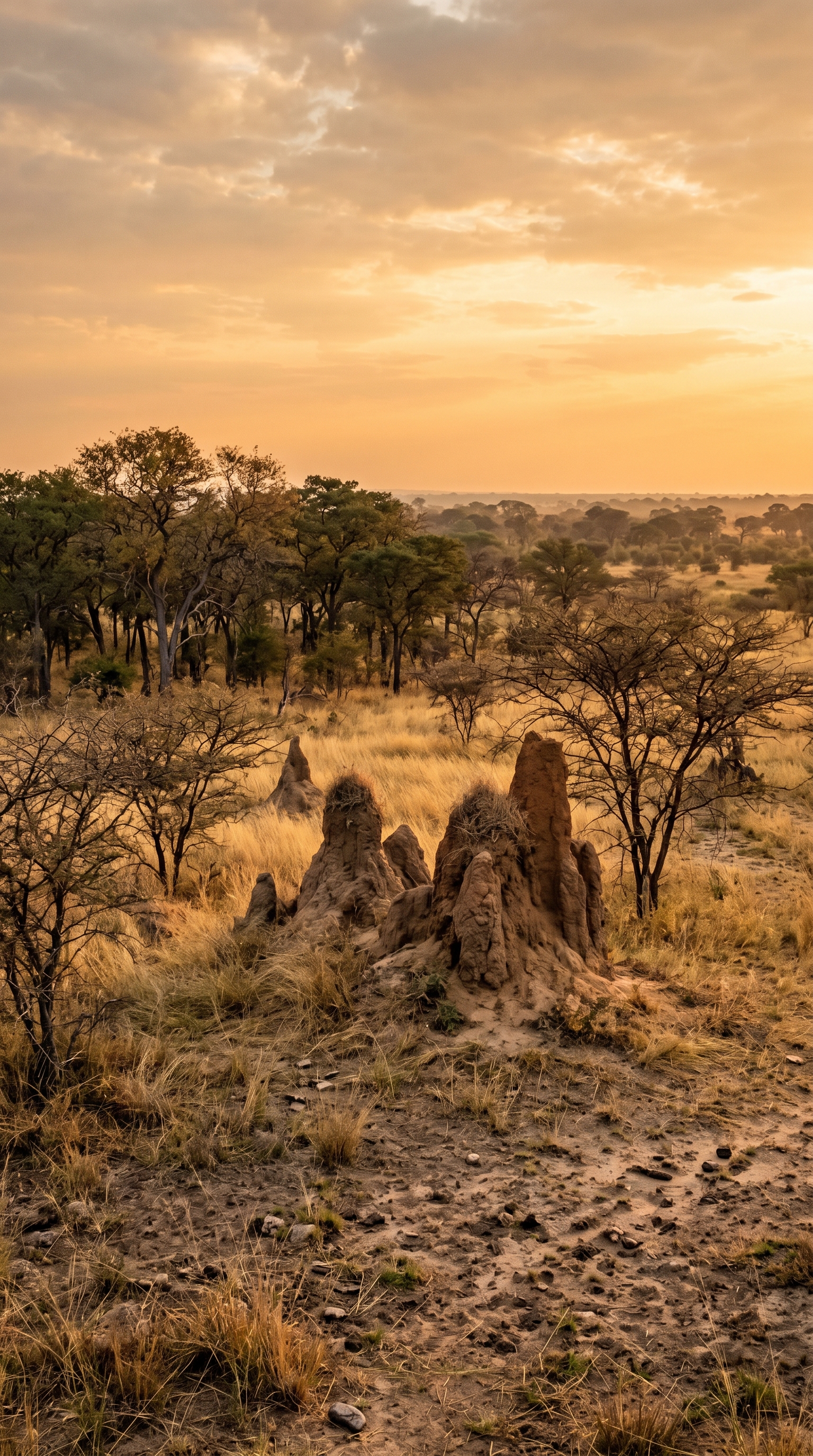
The Okavango Delta, Botswana at ground level — home of the spotted hyena. -
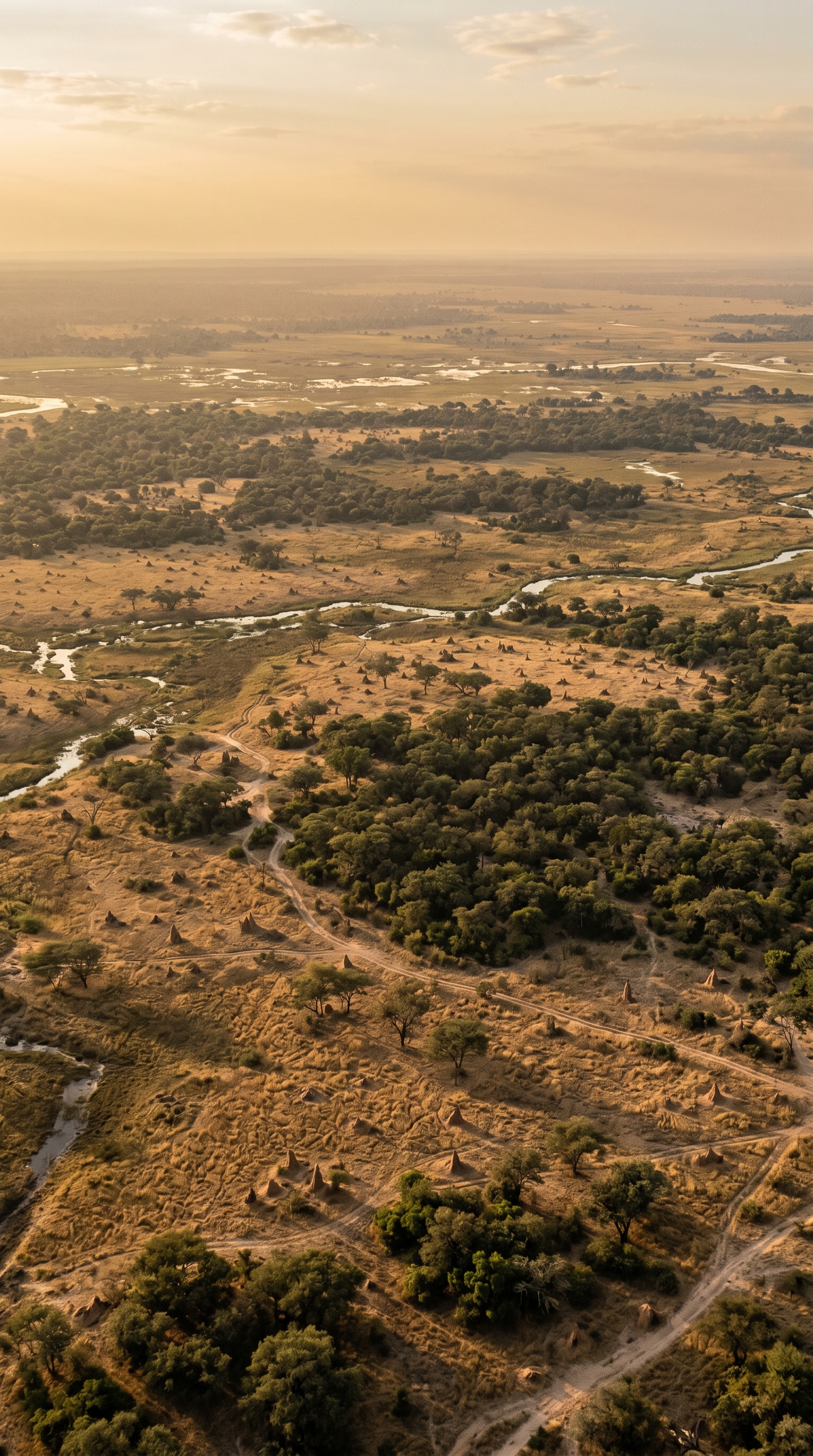
The Okavango Delta, Botswana seen from above — home of the spotted hyena. -
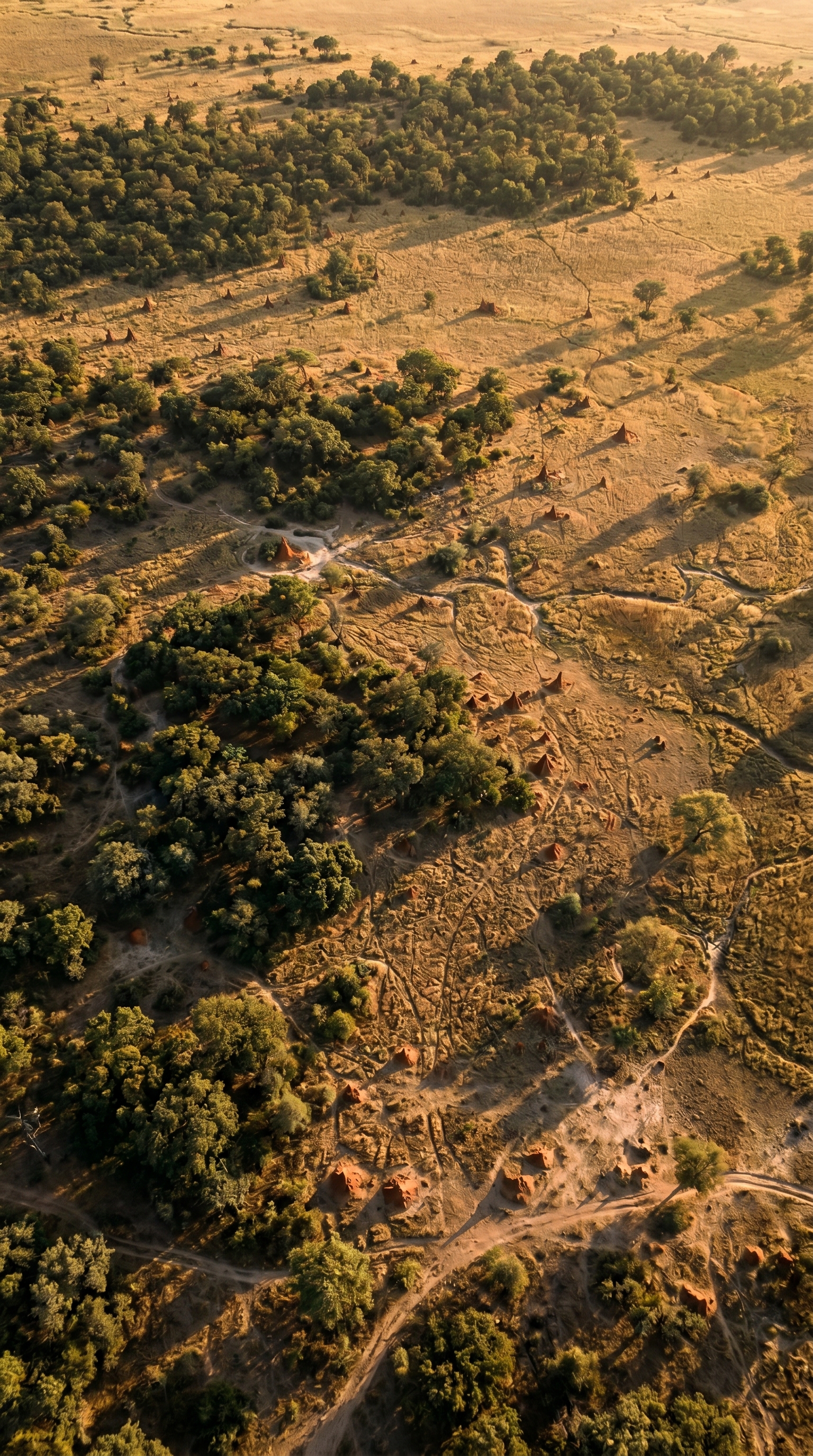
The Okavango Delta, Botswana from high overhead — home of the spotted hyena.
Native range
Spotted hyenas live across much of sub-Saharan Africa, from East African grasslands to Southern African savanna, open woodland, semi-desert, and some mountain country. Their strongest landscapes include the Serengeti-Mara ecosystem, Ngorongoro Crater, Okavango Delta, Kruger, and other places where large herds of wildebeest, zebra, antelope, and buffalo keep the food chain moving.
The range
Five regions, one species.
The spotted hyena doesn't live in one place. Across the map below, each region has its own pressures, prey, and politics — same biology, different worlds.
-
Botswana
The Okavango Delta
Sympatric with the African wild dog. Documented kleptoparasitism on wild dog kills — hyenas track pack hunts and arrive at kill sites to claim prey, forcing the pack to choose between contesting the kill (risking broken bones they cannot afford) or surrendering the meal.
Source ↗ -
Tanzania
Serengeti National Park
Densest hyena population in Africa. Sympatric with Southern African lion (direct competitor) and Nungo (African crested porcupine).
Source ↗ -
South Africa
Kruger National Park
Southern African stronghold. Dominant scavenger and active hunter; sympatric with leopards whose kill-hoisting behaviour is driven by spotted-hyena kleptoparasitism.
Source ↗ -
Kenya
Masai Mara National Reserve
Northern extension of the Serengeti–Mara ecosystem. Long-term Mara Hyena Project (MSU, Holekamp lab) study site — the reference population for most modern clan-structure and female-dominance research.
Source ↗ -
Tanzania
Ngorongoro Conservation Area
Ngorongoro Crater holds one of the highest recorded clan densities in Africa; clan-vs-clan boundary contests are a defining feature of the population.
Source ↗
Daily life
What the spotted hyena does, day to day.
Diet, social behaviour, climate — the everyday biology that shapes how this species hunts, defends and survives.
-
Diet
Apex predator and opportunistic kleptoparasite. Field studies show spotted hyenas are often active hunters, not just scavengers; ADW cites a Kalahari study where about 70% of diet came from direct kills.
-
Social life
Matriarchal, fission-fusion clan society of up to ~80 individuals (exceptional clans reach ~130).
-
Climate
Tropical to subtropical sub-Saharan Africa. Occupies savanna, grassland, open woodland, semi-desert and mountainous terrain up to ~4,000 m elevation.
Wyld Trivia
Five questions. Most people get them wrong.
But you're not most people.
Tap to reveal.
-
How can a spotted hyena crunch a bone that a lion can't break?
Show me HideTheir canine bite force is estimated at about 770 newtons, and their skull, premolars, and carnassials are specialised for cracking bone. Add very acidic stomach juice that can digest bone and hide, and a hyena can use parts of a carcass most predators leave behind.
-
Are spotted hyenas really just scavengers?
Show me HideNo — that's a common myth. In the Kalahari, a study found around 70% of spotted hyena diet came from animals they killed themselves. They're endurance hunters: they can reach up to 60 km/h in pursuit, and one documented Kalahari eland chase lasted 24 km. Those are separate facts, not one continuous top-speed sprint.
-
Who's in charge in a spotted hyena clan?
Show me HideThe females. Female spotted hyenas are about 10% larger than males and they socially outrank every adult male in the clan unless he's a son who hasn't left yet. Cubs inherit their mother's rank for life. It's one of the very few mammal species where females are bigger AND in charge.
-
How big can a spotted hyena clan get?
Show me HideUp to 80 hyenas in a normal clan, with exceptional clans of around 130. They live in fission-fusion groups: members split off to hunt, then come back together at the den. The social structure is so complex that scientists compare it to monkeys — hyenas know who's related to who and who outranks who.
-
Why do leopards drag dead animals up into trees?
Show me HideMostly because of hyenas. Spotted hyenas steal about half of all the kills leopards lose to thieves — and leopards lose around one in five of their kills. Over thousands of years, leopards evolved to haul carcasses up high, where ground-living hyenas can't follow. The hyena drove the leopard upward.
The terrain
Where the spotted hyena thrives.
Every animal is built for some places more than others. These are the ground, hours and weather where this species shows its best — and its worst.
Ground
- Open savanna Excels
- Grassland Excels
- Semi desert Strong
- Open woodland Strong
- Rocky Struggles
- Dense forest Struggles
Hours
- Night Excels
- Dusk Excels
- Twilight Excels
- Dawn Strong
- Day Struggles
Weather
- Moderate Excels
- Hot Strong
- Rain Average
- Wind Average
- Cold Struggles
- Storm Struggles

Five things you didn't know about the spotted hyena.
Cited biology that shapes how the spotted hyena feeds, defends, survives.
-
Female spotted hyenas are larger than males — adult females average ~10% more body mass, with the largest differences in head and neck circumference — and are socially dominant to all adult males not born in their natal clan. The combination of female-larger size dimorphism and female dominance is rare among mammalian carnivores, in which males are usually the larger sex. Source ↗
-
Estimated canine bite force in Crocuta crocuta is about 773 N, with a bite force quotient (BFQ) of 117. The famous bone-cracking ability comes from the whole feeding system: short strong skull, enlarged premolars and carnassials, and acidic digestion that helps process bone. Source ↗
-
Spotted hyenas live in fission-fusion clans of up to ~80 individuals (exceptional clans reach ~130), structured by maternal rank inheritance. Clan complexity and cooperation are comparable to cercopithecine primate societies — hyenas recognise third-party kin and rank relationships and deploy that knowledge in social decision-making. Source ↗
-
Despite the scavenger reputation, a Kalahari study found about 70% of spotted hyena diet came from direct kills. Hyenas are endurance predators: pursuit speeds up to 60 km/h are reported, and one Kalahari eland chase lasted 24 km. Source ↗
-
Leopards lose around 20% of their kills to kleptoparasitism, and spotted hyenas are responsible for roughly half of those thefts. The selective pressure is so strong that leopards have evolved the distinctive arboreal caching behaviour — hoisting carcasses into trees — specifically to keep kills above ground-living hyena reach. Source ↗
About the spotted hyena
Where the spotted hyena sits on the tree of life.
-
Class
Mammalia
Warm-blooded animals with fur or hair that feed their young milk.
-
Order
Carnivora
Mostly meat-eating mammals — cats, dogs, bears and their relatives.
-
Family
Hyaenidae
The hyena family — bone-cracking jaws and complex social groups.
-
Species
Crocuta crocuta
Spotted Hyena — the species this page is about.


Spotted Hyena
Every fact, cited.
Biology cited on this page comes from peer-reviewed zoology and the major species databases. Click through for the underlying study, dataset or assessment.
- PubMed · PubMed
- PubMed · PubMed
- academic.oup.com · academic.oup.com
- Animal Diversity Web · Animal Diversity Web
- panthera.org · panthera.org


