
Giant Forest Hog
Scientific name Hylochoerus meinertzhageni
Adult size
- Weight
- ♀F 100-200 kg ♂M 140-275 kg
- Length
- ♀F 1.75 m ♂M 1.75 m
- Shoulder height
- ♀F 0.95 m ♂M 0.95 m
- Top speed charge
- ♂M 38 km/h
- Lifespan
- Giant Forest Hogs can reach adult size from about 18 months, and reported life can reach 18 years.
Represented by Boma Bwindi Impenetrable Forest, Uganda

Giant forest hogs live in Africa's equatorial forest belt, but not as one unbroken block. Populations are scattered from West African forests in Guinea, Sierra Leone, Liberia, Cote d'Ivoire, and Ghana, through Cameroon, Gabon, Congo, and Central African Republic, to the Albertine Rift highlands of Uganda, Rwanda, Burundi, eastern Democratic Republic of the Congo, and western Kenya. The Albertine Rift is the chain of deep lakes and mountains running through East-Central Africa.
Where they live
Three angles, one home.
The giant forest hog represented in the Wyld Savage League lives in Bwindi Impenetrable Forest, Uganda. Three views of the same patch of country — at ground level, from above, and bird's-eye.
-
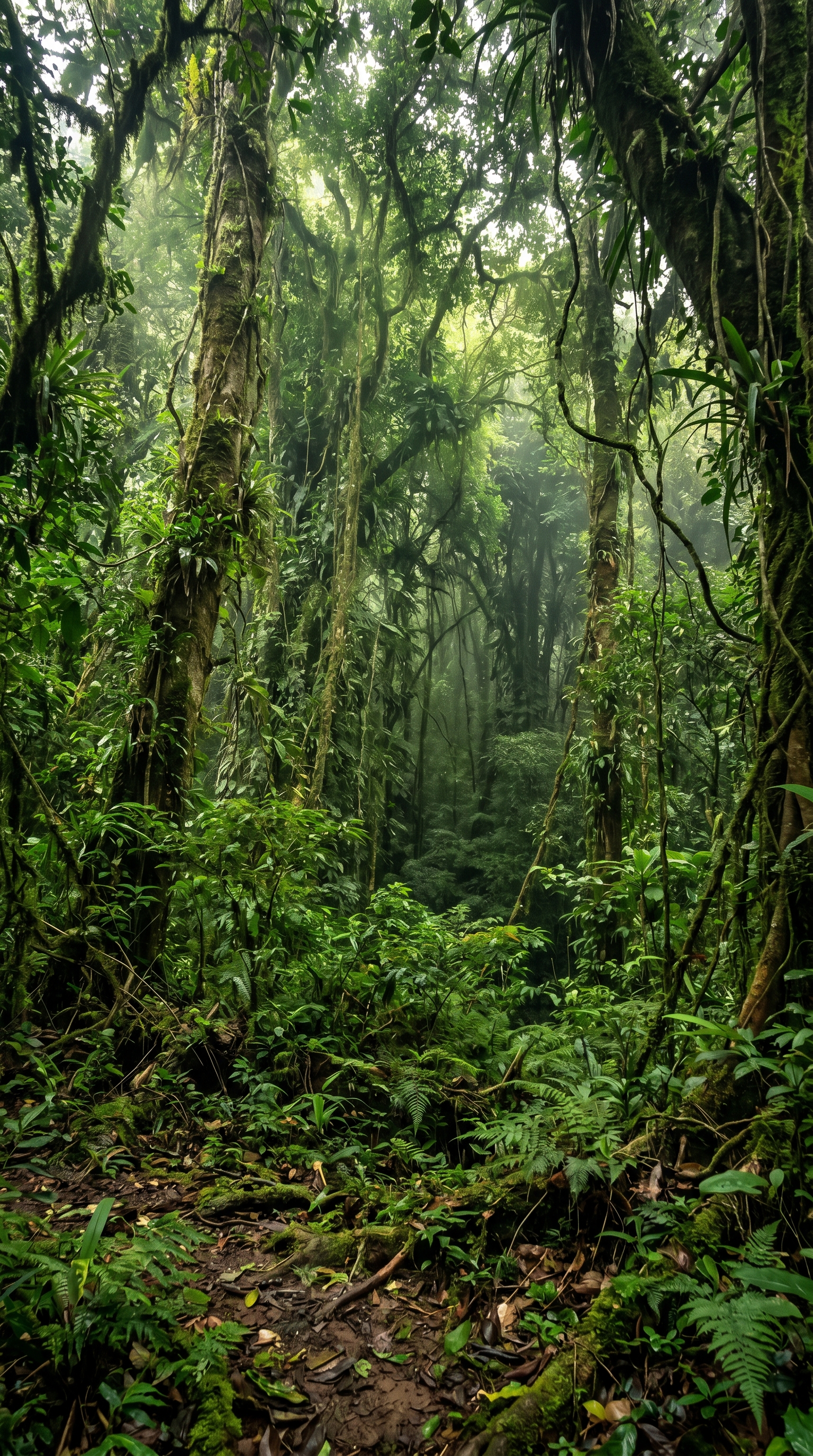
Bwindi Forest at ground level — dense montane jungle where Africa's heaviest wild pig digs for roots and tubers. -
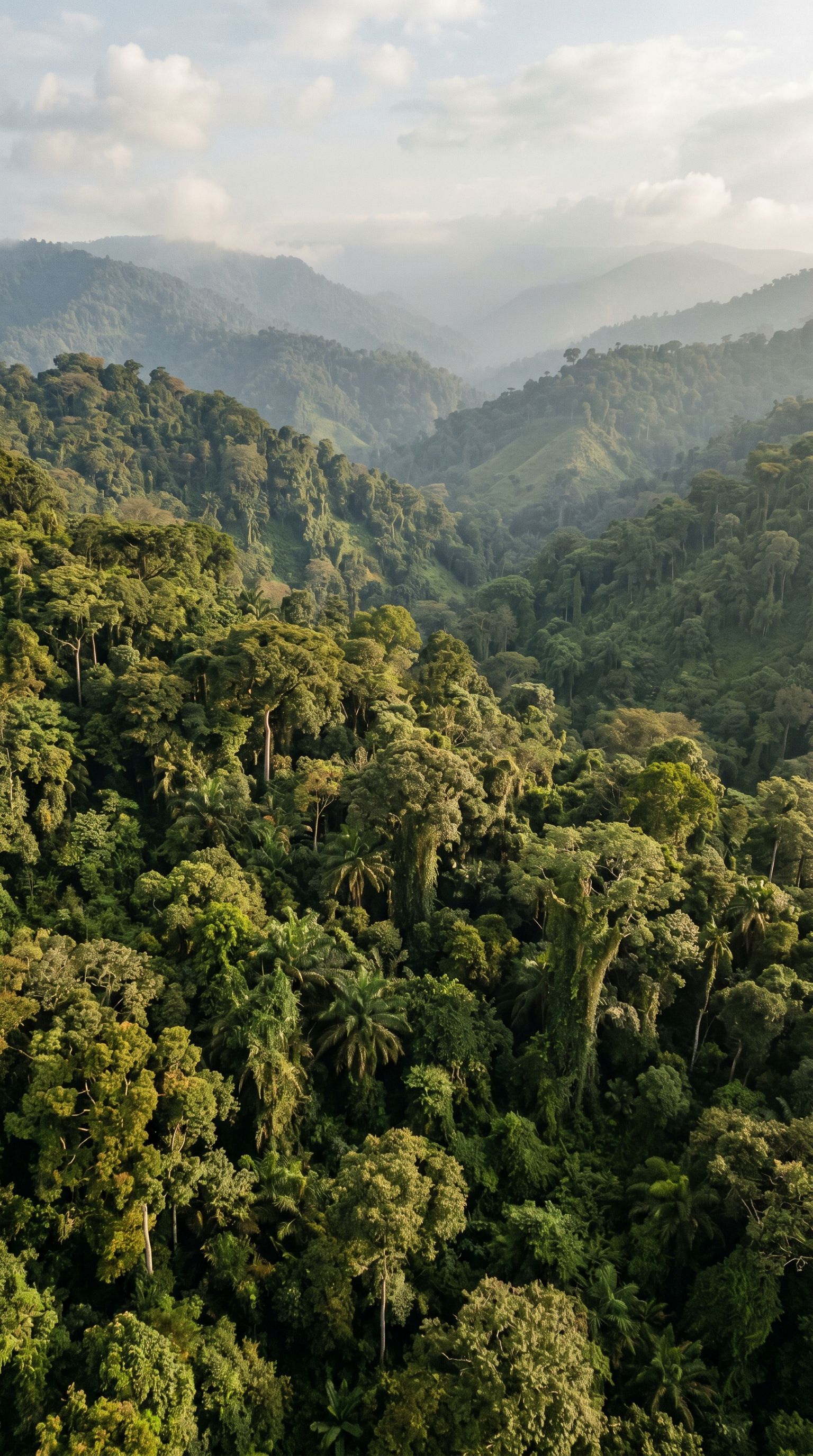
Bwindi Impenetrable Forest from above — Uganda's UNESCO-listed cloud forest, a refuge of last resort for many species. -
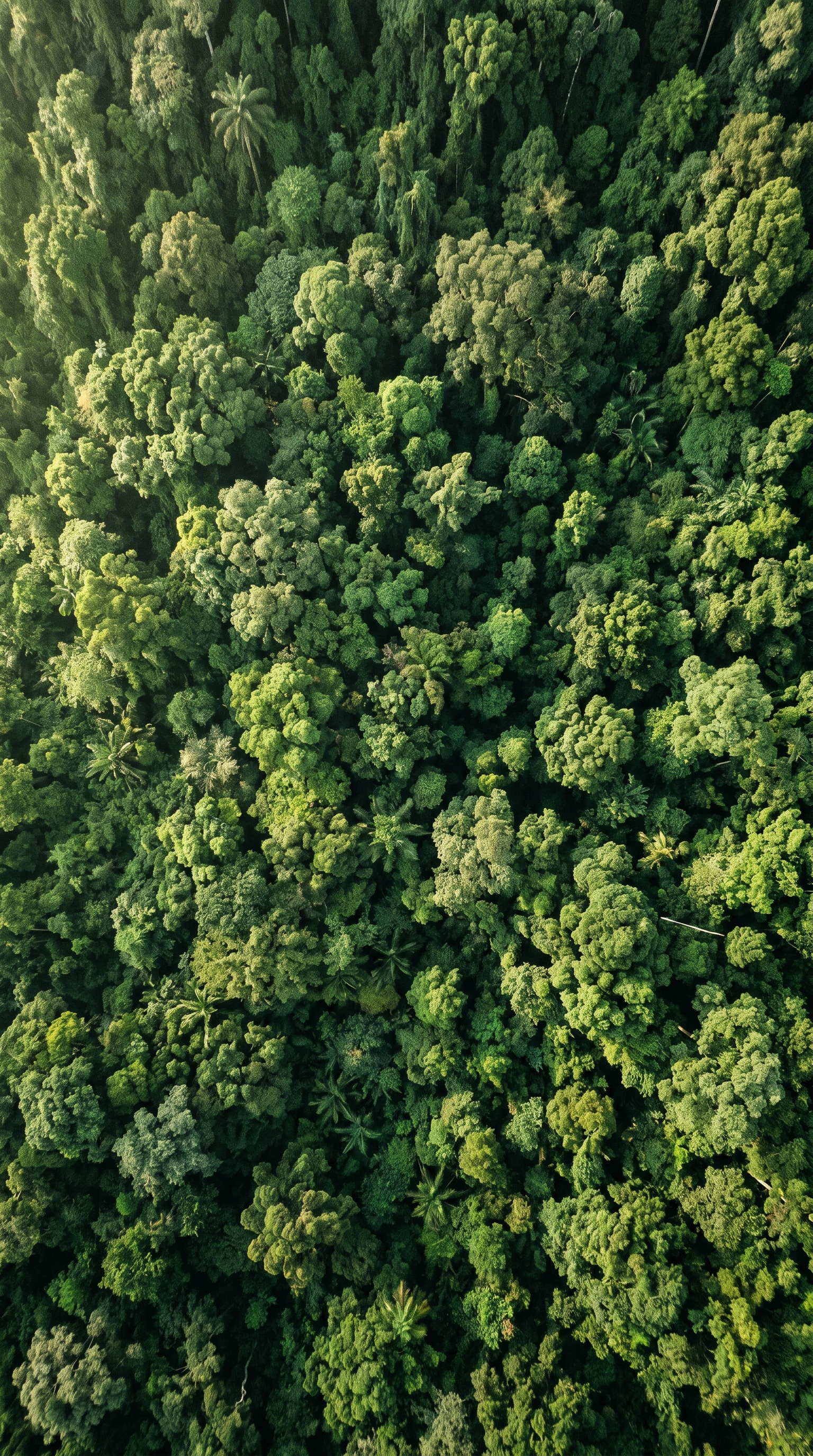
Equatorial Africa from high overhead — Bwindi sits in a thin band of ancient cloud forest along the Albertine Rift.
Native range
Giant forest hogs live in Africa's equatorial forest belt, but not as one unbroken block. Populations are scattered from West African forests in Guinea, Sierra Leone, Liberia, Cote d'Ivoire, and Ghana, through Cameroon, Gabon, Congo, and Central African Republic, to the Albertine Rift highlands of Uganda, Rwanda, Burundi, eastern Democratic Republic of the Congo, and western Kenya. The Albertine Rift is the chain of deep lakes and mountains running through East-Central Africa.
The range
Six regions, one species.
The giant forest hog doesn't live in one place. Across the map below, each region has its own pressures, prey, and politics — same biology, different worlds.
-
Uganda
Bwindi Impenetrable Forest
Boma's home forest. Bwindi supports giant forest hog occurrence, but no public Bwindi-specific body-size or density line is retained.
Source ↗ -
Uganda
Kibale National Park
Uganda conservation context retained as background, not as a biometric source.
Source ↗ -
Uganda
Rwenzori Mountains
Humid montane habitat straddling Uganda–DRC border. Historically continuous range, now fragmented.
Source ↗ -
Kenya
Mount Kenya National Park
Eastern range limit. Montane forest 900–3,800 m.
Source ↗ -
Kenya
Aberdare Range
Second-largest Kenyan population. Montane forest stronghold.
Source ↗ -
Ghana
Kakum National Park
Isolated West African population. Co-occurs with forest elephants. Population size not quantified.
Source ↗
Daily life
What the giant forest hog does, day to day.
Diet, social behaviour, climate — the everyday biology that shapes how this species hunts, defends and survives.
-
Diet
Mostly herbivorous. Giant forest hogs browse and graze on forest vegetation, with Uganda isotope work showing seasonal grass use at the start of the rains.
-
Social life
Lives in sounders, often with several adult females, young animals, and one adult male.
-
Climate
Sea level to 3,800 m elevation. Tolerates cold highland nights (0°C) and hot lowland days — but is sensitive to low humidity and prolonged solar exposure, and is absent from arid regions.
Wyld Trivia
Five questions. Most people get them wrong.
But you're not most people.
Tap to reveal.
-
What's the world's biggest wild pig — and how big can it get?
Show me HideThe giant forest hog. The IUCN Wild Pig Specialist Group lists adult males at 140 to 275 kilograms, with females at 100 to 200 kilograms. Boma is set at 180 kilograms, so he is a big adult male without being outside the real range.
-
How do two giant forest hog males compete?
Show me HideWith close-range force. Adult males use size, tusks, broad heads, and pushing power when rivals get too close. That is the real-world root of Boma's heavy, head-on defence style.
-
What does a giant forest hog eat?
Show me HideGiant forest hogs are mainly plant eaters that browse and graze. Uganda research shows seasonal grass use, and they can dig salty earth with tusks and lower incisors.
-
Why do giant forest hogs use mud and wallows?
Show me HideMud and thick cover matter because giant forest hogs live in hot, wet forest places. Wallowing is one of their regular activities in some areas, especially around forested cover and water.
-
How does a giant forest hog family live together?
Show me HideThey often live in sounders, with adult females, young hogs, and adult males. Large males can be strong defenders of their groups, which is the real-world root of Boma's protector role.
The terrain
Where the giant forest hog thrives.
Every animal is built for some places more than others. These are the ground, hours and weather where this species shows its best — and its worst.
Ground
- Dense forest Excels
- Montane forest Excels
- Forest edge ecotone Strong
- Grassland clearing Struggles
- Open savanna Avoids
Hours
- Dusk Excels
- Twilight Excels
- Dawn Strong
- Night Strong
- Day Struggles
Weather
- Moderate Strong
- Cold Strong
- Hot Average
- Rain Average
- Wind Average
- Storm Struggles

Five things you didn't know about the giant forest hog.
Cited biology that shapes how the giant forest hog feeds, defends, survives.
-
Giant forest hogs are the largest wild pigs on Earth, and adult males are much heavier than females. Source ↗
-
Adult male giant forest hogs are listed at 140-275 kg by the IUCN SSC Wild Pig Specialist Group. Source ↗
-
The species has a broad head, prominent tusks, and large cheek swellings that are strongest in adult males. Source ↗
-
Uganda diet research supports a mixed plant-feeding picture, including seasonal grass use rather than a simple one-food diet. Source ↗
-
Bwindi records confirm giant forest hogs in Boma's home forest, but those records do not provide a special Bwindi stat line. Source ↗
About the giant forest hog
Where the giant forest hog sits on the tree of life.
-
Class
Mammalia
Warm-blooded animals with fur or hair that feed their young milk.
-
Order
Artiodactyla
Hoofed mammals with an even number of toes — pigs, deer, cattle.
-
Family
Suidae
Pigs and their wild relatives — tough omnivores with tusks.
-
Species
Hylochoerus meinertzhageni
Giant Forest Hog — the species this page is about.


Giant Forest Hog
Every fact, cited.
Biology cited on this page comes from peer-reviewed zoology and the major species databases. Click through for the underlying study, dataset or assessment.
- iucn-wpsg.org · iucn-wpsg.org
- iucn-wpsg.org · iucn-wpsg.org
- iucn-wpsg.org · iucn-wpsg.org
- doi.org · doi.org
- doi.org · doi.org


