
Saltwater Crocodile
Scientific name Crocodylus porosus
Adult size
- Weight
- ♀F 150 kg ♂M 500 kg
- Length
- ♀F 2.6 m ♂M 5.2 m
- Body height
- ♀F 0.38 m ♂M 0.55 m
- Top speed
- ♀F 29 km/h ♂M 29 km/h
- Lifespan
- Saltwater crocodiles can live to about 70 years, while extreme old-age claims are best treated carefully rather than promised for every animal.
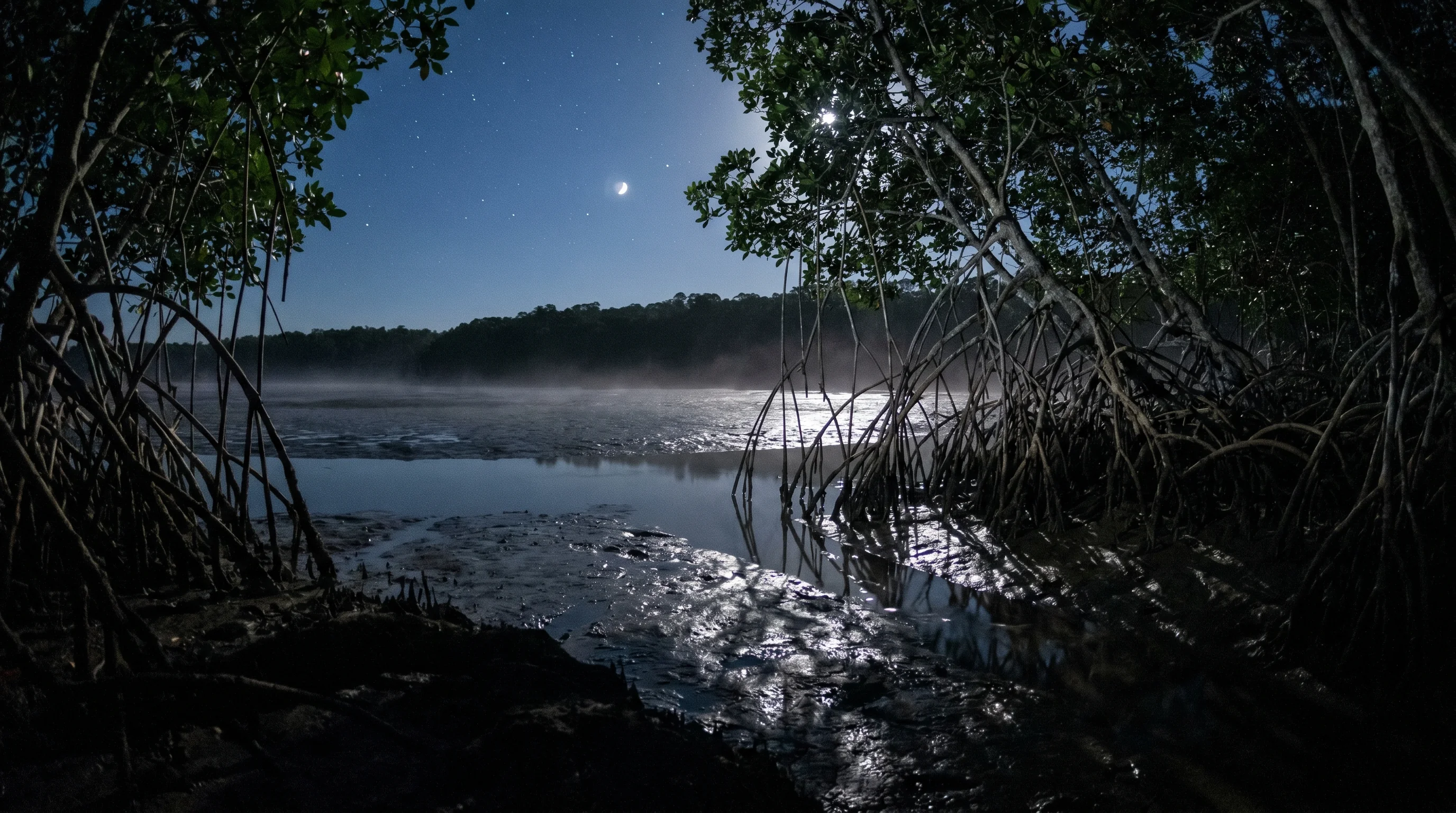
Saltwater crocodiles range across the Indo-Pacific, from eastern India and the Sundarbans through Southeast Asia, Indonesia, Papua New Guinea, the Solomon Islands, Vanuatu, and northern Australia. They use mangrove creeks, estuaries, tidal rivers, freshwater floodplains, coastal lagoons, and even sea crossings between islands. In Australia, Kakadu and the Top End are classic strongholds.
The range
Six regions, one species.
The saltwater crocodile doesn't live in one place. Across the map below, each region has its own pressures, prey, and politics — same biology, different worlds.
-
Australia
Kakadu National Park, Northern Territory
Type-example Australian stronghold: intact estuarine–freshwater floodplain mosaic with one of the highest densities of adult saltwater crocodiles in the world. World Heritage-listed; long-running population monitoring since the 1970s post-hunting recovery.
Source ↗ -
Australia
Daintree National Park
Wet Tropics coastal rainforest and tidal river system on the Queensland east coast; adjacent to the Great Barrier Reef marine corridor used by ocean-travelling adults. Sympatric with Southern Cassowary (*Casuarius casuarius johnsonii*) at lowland river crossings — documented wet-season predation mortality on adult cassowaries attempting to cross flooded Daintree / Mossman river systems per Queensland Cassowary Recovery Plan and DCCEEW EPBC Significant Impact Guidelines. Range-string normalised to bare 'Daintree National Park' (Bialowieza precedent) for validator Rule 1 exact-match with southern-cassowary.md. Muruk-nemesis sympatry anchor (Group G4, Session 10).
Source ↗ -
Bangladesh
Sundarbans Reserve Forest
Largest contiguous mangrove forest in the world, shared across Bangladesh and India. Sympatric with Bengal tigers (Panthera tigris tigris) — the tigers that swim between mangrove islands are the same tigers that share the water with C. porosus.
Source ↗ -
India
Bhitarkanika National Park, Odisha
Highest-density saltwater crocodile population in India, centred on the Brahmani-Baitarani delta mangroves. Historical site of the largest documented wild specimens on the Indian subcontinent.
Source ↗ -
Indonesia
Lorentz National Park, West Papua (New Guinea)
UNESCO World Heritage site spanning glacier-to-sea habitat on the island of New Guinea; lowland coastal and estuarine reach supports substantial C. porosus populations sympatric with Asian water monitors and reticulated pythons.
Source ↗ -
Thailand
Tarutao Marine National Park, Satun
Andaman Sea island group — one of the few remaining Thai sites with confirmed wild saltwater crocodile occurrence; relevant to the ocean-dispersal behaviour documented by Campbell et al. 2010, since Tarutao sits on the island-hopping corridor between peninsular Malaysia and the Andaman–Nicobar chain.
Source ↗
Daily life
What the saltwater crocodile does, day to day.
Diet, social behaviour, climate — the everyday biology that shapes how this species hunts, defends and survives.
-
Diet
Apex carnivore and opportunistic generalist. Juveniles take insects, amphibians, crustaceans, and small fish and reptiles.
-
Social life
Solitary and strongly territorial. Dominant males hold and defend long stretches of estuarine river — territories of up to ~500 km² of navigable waterway are reported from Australian radio-tracking studies.
-
Climate
Tropical and sub-tropical. Occupies estuarine, mangrove, freshwater river, coastal marine, and open-ocean habitat — the most salt-tolerant extant crocodilian.
Wyld Trivia
Five questions. Most people get them wrong.
But you're not most people.
Tap to reveal.
-
How can one animal's bite get stronger mostly just by getting bigger?
Show me HideAcross all crocodilians, bite force rises strongly with body size. Erickson's 2012 study tested 83 individuals from every living crocodilian species using force transducers — the famous 16,414 Newton number came from one very large captive saltwater crocodile, not all wild adults. So a 5-metre saltie bites harder than a 3-metre one of the same species; a same-sized alligator bites about as hard as a same-sized croc.
-
How can a huge reptile use the sea almost like a moving road?
Show me HideAcoustic and satellite tags showed adult saltwater crocodiles in northern Australia move long distances when surface currents are favourable — and stop or dive when the current reverses. They hitch rides on the tide. That's how they spread between coasts and islands without swimming non-stop. The safest framing is long coastal and sea journeys with current help, not random open-ocean wandering.
-
Why spin instead of just biting harder?
Show me HideA 'death roll' is a twisting feeding move. A crocodilian grips its prey, then spins its whole body in the water — fast — to make twisting forces. This can help tear off a chunk that's too big to swallow, or overpower struggling prey. Biomechanics experiments on alligators show how it works, so the safer wording is 'across crocodilians,' not specific to saltwater crocs alone.
-
What happens at a crocodile nest when the eggs start to hatch?
Show me HideFemale saltwater crocodiles do more than lay eggs and walk away. Field studies in northern Australia found mothers staying close to the nest mound, and getting actively involved when the eggs are hatching — gathering hatchlings into a group called a creche. This is real parental care, but more like nest-and-hatchling attendance than the long-term care birds and mammals do.
-
Where are people most at risk from a saltwater crocodile attack?
Show me HideIn or very near the water. In a Northern Territory review of 1971 to 2013 records, scientists counted 18 fatal and 45 non-fatal attacks. Most happened to people in or right at the water's edge. Larger crocodiles were more likely to kill. The popular claim that saltwater crocs kill more humans than sharks isn't supported by this evidence — folklore isn't a data source.
The terrain
Where the saltwater crocodile thrives.
Every animal is built for some places more than others. These are the ground, hours and weather where this species shows its best — and its worst.
Ground
- Estuary Excels
- Mangrove Excels
- River Excels
- Coastal Strong
- Open ocean Strong
- Freshwater Strong
- Inland terrestrial Avoids
Hours
- Night Excels
- Dusk Excels
- Twilight Excels
- Dawn Strong
- Day Average
Weather
- Hot Excels
- Moderate Strong
- Rain Strong
- Wind Average
- Storm Average
- Cold Avoids
Five things you didn't know about the saltwater crocodile.
Cited biology that shapes how the saltwater crocodile feeds, defends, survives.
-
Crocodylus porosus produced the highest bite force ever measured on any living animal. Erickson and colleagues (2012, PLOS ONE) tested 83 adult specimens across all 23 extant crocodilian species using sandwich transducers; a single saltwater crocodile generated 16,414 N (3,689 lbf) at the molariform teeth. Extrapolated to 6.7 m wild specimens beyond the tested size range, the regression predicts bite forces of 27,531–34,424 N (6,187–7,736 lbf). Source ↗
-
The saltwater crocodile is the largest living reptile. Adult males can reach 6-7 m total length and 1,000-1,200 kg, with females rarely exceeding 3 m; specimens around 5.2 m / 454 kg are average for large adults, and ~7 m / 1,000 kg specimens are recorded across the Indo-Pacific range. Source ↗
-
Satellite-tracked translocated saltwater crocodiles have documented homing journeys of more than 400 km along the Australian coast — one male released on the east coast of Cape York Peninsula circumnavigated the tip of the peninsula and covered ~411 km of coastal and ocean travel in 20 days back to its original capture site, reaching over 30 km in a single day. This is the longest documented homeward journey for any crocodilian. Source ↗
-
C. porosus rides tidal and residual ocean currents to cross open water between habitat patches. Campbell and colleagues (2010, Journal of Animal Ecology) tracked adult crocodiles in northern Australia and showed a tight correlation (r² = 0.92) between the bearing of the surface current and the bearing of the travelling crocodile. Individuals travelled only when flow direction was favourable and dove to the substrate or climbed out on the bank when it reversed. Source ↗
-
Indefinite marine residence is made possible by specialised lingual salt glands. Taplin & Grigg (1981, Science) identified 28–40 individual salt-secreting glands opening separately onto the dorsal surface of the crocodile's tongue, which exude a concentrated sodium chloride secretion. The glands are phenotypically plastic — blood supply and Na⁺/K⁺-ATPase expression both scale up with environmental salinity — and combined with ion-transporting modifications in the urodaeum and rectum they enable C. porosus to thrive across fresh, brackish, and fully marine conditions. Source ↗
About the saltwater crocodile
Where the saltwater crocodile sits on the tree of life.
-
Class
Reptilia
Cold-blooded animals with scales — like crocodiles, lizards and snakes.
-
Order
Crocodilia
The large semi-aquatic reptiles — crocodiles, alligators and gharials.
-
Family
Crocodylidae
True crocodiles — narrow-jawed reptiles with bone-crushing bite.
-
Species
Crocodylus porosus
Saltwater Crocodile — the species this page is about.


Saltwater Crocodile
Every fact, cited.
Biology cited on this page comes from peer-reviewed zoology and the major species databases. Click through for the underlying study, dataset or assessment.
- PLOS · PLOS
- Animal Diversity Web · Animal Diversity Web
- PLOS · PLOS
- PubMed · PubMed
- PubMed · PubMed


