
Yacare Caiman
Scientific name Caiman yacare
Adult size
- Weight
- ♀F 17.5 kg ♂M 39 kg
- Length
- ♀F 1.58 m ♂M 2.04 m
- Body height
- Not reported for this species
- Top speed lunge
- 15 km/h
- Lifespan
- Yacare Caiman lifespan is estimated around 30 years in the wild, with captivity estimates up to 50 years.
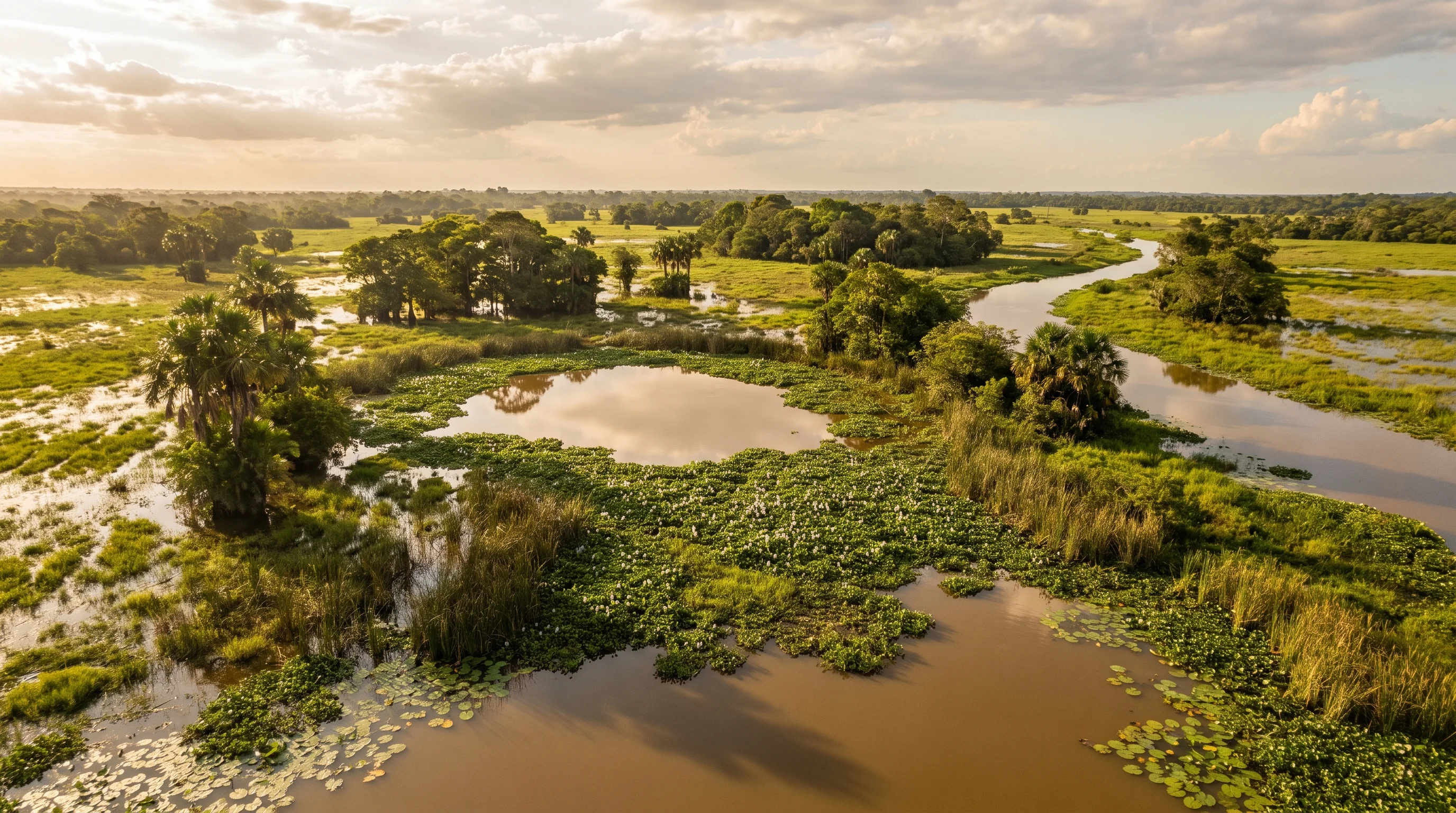
Yacare caiman live in the wetlands of central South America, especially the Pantanal, the world's largest tropical wetland, spread across south-western Brazil, eastern Bolivia, and northern Paraguay. They also live in the Paraguay River basin into northern Argentina, including the Ibera wetlands. Their world changes with the water: flooded grassland in the wet season, then shrinking pools, oxbow lakes, rivers, and marsh edges in the dry.
The range
Five regions, one species.
The yacare caiman doesn't live in one place. Across the map below, each region has its own pressures, prey, and politics — same biology, different worlds.
-
Brazil
Pantanal Wetlands
Primary stronghold — world's largest tropical wetland and the type-example Yacare Caiman habitat. Highest-density Pantanal caiman populations in the world, directly overlapping with the Pantanal jaguar population that anchors the B2 Jagua nemesis relationship.
Source ↗ -
Brazil
Pantanal Matogrossense National Park, Mato Grosso
Federal national park on the Paraguay / Cuiabá river confluence; formally protected core of the Brazilian Pantanal caiman population.
Source ↗ -
Bolivia
Llanos de Moxos / Beni Department (Mamoré-Beni system)
Seasonally-flooded savanna and riverine corridor of lowland Bolivia. Type locality for the C. y. medemi subspecies (Laguna Suárez, near Trinidad).
Source ↗ -
Paraguay
Paraguayan Chaco / upper Paraguay River basin
Country of the species' primary type locality (Daudin, 1802). Upper Paraguay basin and Chaco wetland complex.
Source ↗ -
Argentina
Esteros del Iberá, Corrientes
Argentine southern range extreme — large wetland complex recovered under Iberá National Park / rewilding protection following 20th-century hide-hunting depletion. Populations are now re-established rather than historical-only.
Source ↗
Daily life
What the yacare caiman does, day to day.
Diet, social behaviour, climate — the everyday biology that shapes how this species hunts, defends and survives.
-
Diet
Opportunistic carnivore with a mixed, habitat-dependent diet — NOT a mollusc specialist as popular framing often implies.
-
Social life
Loosely gregarious but territorial.
-
Climate
Tropical to sub-tropical wetland specialist. Occupies the seasonally-flooded Pantanal mosaic of permanent wetland, riverine corridor, oxbow lake, and pulsed floodplain grassland across Brazil, Bolivia, Paraguay, and northern Argentina.
Wyld Trivia
Five questions. Most people get them wrong.
But you're not most people.
Tap to reveal.
-
Which jaguars eat a lot of yacare caiman?
Show me HideSouthern Pantanal jaguars — at least where it's been carefully studied. Researchers GPS-tracked 10 jaguars in the southern Pantanal across three years. They followed clusters of jaguar locations on foot to find kill sites, and yacare caiman showed up at 24.4% of 415 kill sites — one of the jaguar's main prey there. This is strong evidence for that one study system. Whether jaguar populations elsewhere eat caiman at similar rates is a different question — kill-site methods also work better for medium and large prey than for tiny things eaten whole.
-
Why does the Pantanal flood matter for jaguars and caiman?
Show me HideBecause the flood pulse changes where caiman are — and where they're easy to hunt. A southern Pantanal scat-analysis study found caiman became a bigger share of jaguar prey in the WET season. When the floodplain spreads out, caiman disperse across the flooded landscape and become more findable. In the dry season, caiman crowd into shrinking pools — but they're also harder to ambush from the bank. The Pantanal's annual flood pulse drives a year-round predator-prey dance, and jaguar diet shifts with it.
-
Are yacare caiman really 'snail crushers'?
Show me HideLess than the nickname suggests. Pantanal stomach studies (Santos et al. 1996) show yacare eat a MIXED diet that changes with habitat — fish AND water invertebrates are both important, not invertebrate-dominated. Jaw-shape studies (Blanco et al. 2023, PeerJ) compared yacare to its cousin the broad-snouted caiman and found yacare actually has a SLIMMER lower jaw — the shell-breaking jaw is stronger in the broad-snouted species, not yacare. So yacare CAN eat snails. But calling it a snail specialist overstates the case. The 'piranha caiman' nickname is more about teeth shape than evidence.
-
Was the yacare caiman ever in real trouble?
Show me HideYes — and monitored Pantanal populations recovered well. In the 1970s and 1980s, Pantanal yacare caiman were heavily hunted for their skins. Population analysis (Mourão et al. 1996) of illegally harvested AND surviving caimans showed the crash hit large adults especially hard. After protection, aerial surveys (Mourão et al. 2000) found yacare abundant again across monitored Brazilian Pantanal systems. The IUCN classifies the species as Least Concern. Scientists do NOT have a precise pre-hunting count — before-and-after totals should be used carefully — but the recovery in monitored parts of the Pantanal is real and well-documented.
-
How do caiman cope when the Pantanal dries out?
Show me HideThey crowd — and life gets harder. Long-term work in the Brazilian Pantanal (Campos et al. 2006) shows yacare spread across the flooded landscape in the wet season and crowd into the water that stays in the dry. Local density rises in shrinking pools — but that's because water is leaving, not because caiman just had babies (Coutinho & Campos 1996). One Paraguay basin study (Campbell et al. 2008) found that as the dry season deepens, some yacare eat less and start using fat stores — shrinking water can make life genuinely harder. Surviving the dry season is its own challenge.
The terrain
Where the yacare caiman thrives.
Every animal is built for some places more than others. These are the ground, hours and weather where this species shows its best — and its worst.
Ground
- Wetland Excels
- River Excels
- Oxbow lake Excels
- Seasonally flooded savanna Strong
- Mangrove edge Average
- Forest floor Struggles
- Open plains Avoids
Hours
- Night Excels
- Dusk Excels
- Twilight Excels
- Dawn Strong
- Day Average
Weather
- Hot Excels
- Moderate Strong
- Rain Strong
- Wind Average
- Storm Average
- Cold Avoids
Five things you didn't know about the yacare caiman.
Cited biology that shapes how the yacare caiman feeds, defends, survives.
-
In one GPS-collar study from the southern Pantanal, yacare caiman were one of the jaguar's main prey: scientists followed clusters of jaguar locations on foot and reported yacare at 24.4% of 415 kill sites. This is strong regional evidence from a direct kill-site method — not a rule for every jaguar population across the species' range. Kill-site methods also detect medium and large prey better than prey eaten completely. Source ↗
-
In the same southern Pantanal study system, caiman became a bigger share of jaguar prey in the wet season, showing how the Pantanal's annual flood pulse changes hunting opportunities — caimans dispersed across the flooded landscape are more accessible than dry-season clustered ones. This seasonal pattern is strong for that region; jaguar diets look different in other habitats and other parts of the range. Source ↗
-
Yacare caiman do NOT look like simple snail specialists in Pantanal stomach studies. Santos et al. (1996, Herpetological Journal) documented mixed habitat-dependent diets with fish AND water invertebrates both important — not invertebrate-dominated. Geometric morphometric analysis of caiman lower jaws (Blanco et al. 2023, PeerJ) confirms yacare has a slimmer lower jaw than the sympatric broad-snouted caiman (Caiman latirostris); the more robust shell-breaking jaw form is stronger in C. latirostris, not in C. yacare. Yacare CAN eat snails and other hard prey, but the popular 'piranha caiman / mollusc specialist' framing overstates the case. Source ↗
-
Current taxonomy treats Caiman yacare as a full species, but older literature treats it as the subspecies Caiman crocodilus yacare. NCBI Taxonomy lists the name as Caiman yacare (Daudin, 1802) with Caiman crocodilus yacare as a homotypic synonym; molecular phylogenetic work within the Caiman crocodilus/yacare complex supports the species-level split, and the Reptile Database recognises two current subspecies: C. y. yacare and C. y. medemi (Donoso-Barros, 1974). Source ↗
-
Hide hunting caused a real crash in Pantanal yacare populations and hit large animals especially hard (Mourão et al. 1996, Biological Conservation — size-structure analysis of illegally harvested vs surviving caimans). After protection, monitored parts of the Brazilian Pantanal showed strong recovery — aerial surveys (Mourão et al. 2000, Biological Conservation) found yacare abundant again. Density still varies a lot with habitat, water level, and survey methodology. Scientists do not have a precise count of how many yacare lived in the whole Pantanal before the skin trade (Coutinho 2000); before-and-after totals should be used carefully. Source ↗
About the yacare caiman
Where the yacare caiman sits on the tree of life.
-
Class
Reptilia
Cold-blooded animals with scales — like crocodiles, lizards and snakes.
-
Order
Crocodilia
The large semi-aquatic reptiles — crocodiles, alligators and gharials.
-
Family
Alligatoridae
Alligators and caimans — broad-snouted crocodilian ambush predators.
-
Species
Caiman yacare
Yacare Caiman — the species this page is about.


Yacare Caiman
Every fact, cited.
Biology cited on this page comes from peer-reviewed zoology and the major species databases. Click through for the underlying study, dataset or assessment.
- bioone.org · bioone.org
- doi.org · doi.org
- doi.org · doi.org
- PubMed · PubMed
- doi.org · doi.org


