
Cape Buffalo
Scientific name Syncerus caffer caffer
Adult size
- Weight
- ♀F 550 kg ♂M 700 kg
- Length
- ♀F 2.6 m ♂M 2.9 m
- Shoulder height
- ♀F 1.45 m ♂M 1.55 m
- Top speed
- ♀F 57 km/h ♂M 57 km/h
- Lifespan
- Cape Buffalo can reach about 22 years in the wild and 29.5 years in captivity, though many adults die younger.
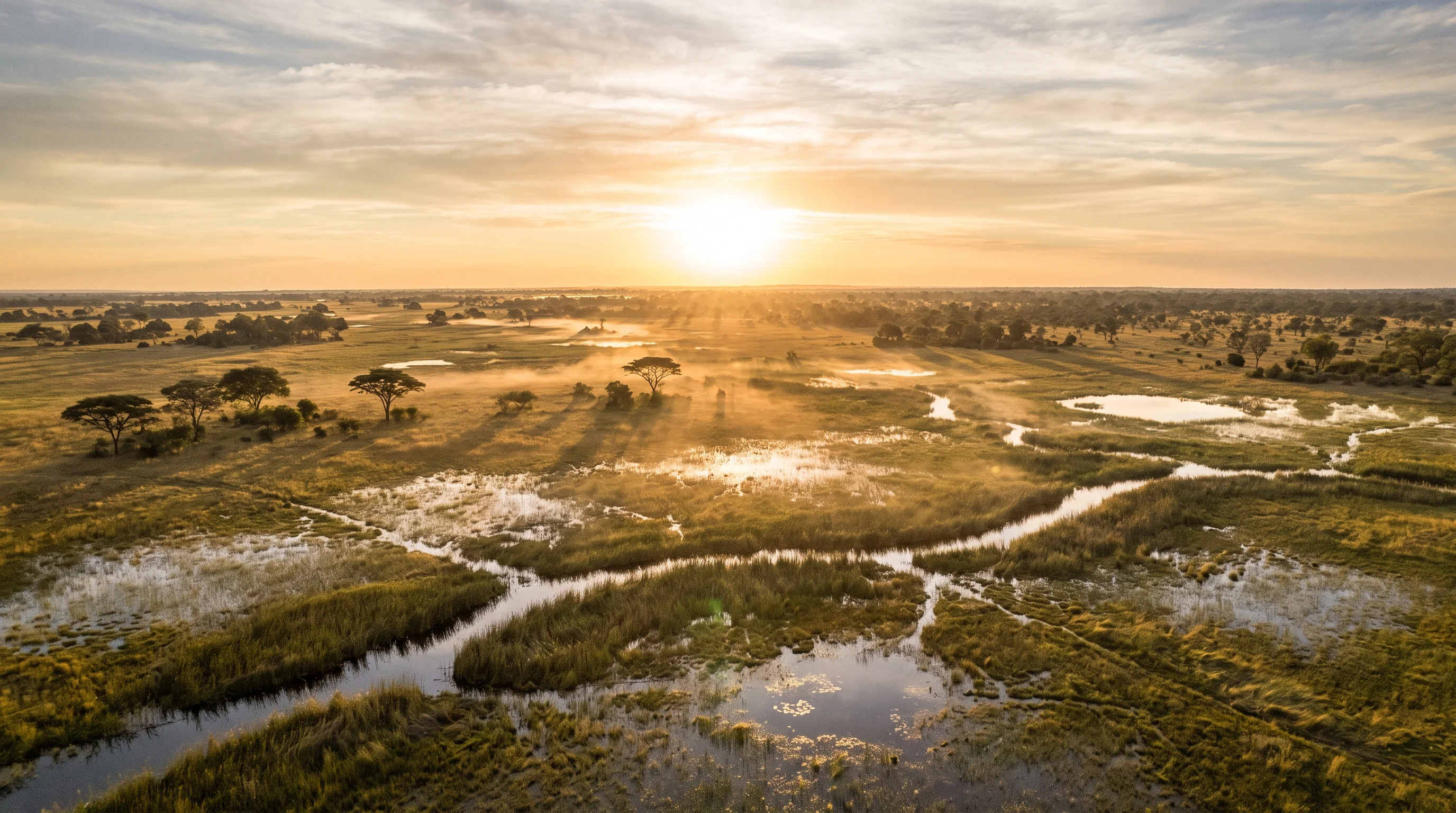
Cape buffalo belong to open, water-rich East and Southern Africa: the Serengeti, Kruger, Okavango Delta, Hwange, Katavi, the Masai Mara, and other savanna strongholds from Kenya and Tanzania down to Botswana, Zimbabwe, Mozambique, Namibia, and South Africa. They are animals of grass, mud, and permanent water - floodplains, open savanna, woodland edges, and river corridors where a herd can see lions coming.
The range
Six regions, one species.
The cape buffalo doesn't live in one place. Across the map below, each region has its own pressures, prey, and politics — same biology, different worlds.
-
Tanzania
Serengeti National Park
Serengeti ecosystem super-herds of 1,500+ documented during rainy-season grass flushes; long-term study site for buffalo ecology.
Source ↗ -
South Africa
Kruger National Park
One of the largest protected Cape buffalo populations; major stronghold for S. c. caffer and long-term predator-prey research site.
Source ↗ -
Botswana
Okavango Delta
Floodplain grazing habitat; classic lion-buffalo mobbing-defense dynamics documented here (Duba Plains).
Source ↗ -
Zimbabwe
Hwange National Park
Zimbabwe's largest national park; significant Cape buffalo population in dry-miombo / Kalahari-sand habitat.
Source ↗ -
Kenya
Masai Mara National Reserve
Northern extension of the Serengeti-Mara ecosystem; home of the famous 'Battle at Kruger'-style lion-buffalo confrontations.
Source ↗ -
Tanzania
Katavi National Park
Remote western Tanzania; hosts some of the continent's largest remaining buffalo super-herds (2,000+ reported around the Katuma floodplain in the dry season).
Source ↗
Daily life
What the cape buffalo does, day to day.
Diet, social behaviour, climate — the everyday biology that shapes how this species hunts, defends and survives.
-
Diet
Obligate grazer. Grass forms the bulk of the diet (primarily C4 species), with sedges and limited browse during dry-season shortages; over 60 grass species recorded across the range.
-
Social life
Highly gregarious and matriarchal. Mixed-sex herds of S. c. caffer typically number 50–500 individuals, with super-herds of 1,500+ documented in the Serengeti and Katavi during rainy-season grass flushes.
-
Climate
Tropical and subtropical savanna; water-dependent. Comfort band roughly 15–35 °C; the species occupies elevations from sea level up to 4,000+ m but avoids deep closed-canopy forest (that niche is held by the smaller S.
Wyld Trivia
Five questions. Most people get them wrong.
But you're not most people.
Tap to reveal.
-
How can a herd stay together if it keeps breaking into smaller groups?
Show me HideCape buffalo herds aren't one fixed block. Field studies in Kruger track herds that split into smaller groups, then rejoin later — and some buffalo keep tighter ties with certain herd-mates than chance alone would predict. Scientists call this fission–fusion. So a 500-strong herd might temporarily become five groups of 100, then merge again at water. The herd is real, but it's flexible.
-
Why would a buffalo herd choose open ground when lions are nearby?
Show me HideCape buffalo herds CAN defend themselves against lions — and sometimes counter-attack. But it's not automatic. A field study in South Africa, comparing buffalo behaviour before and after lion reintroduction, showed bigger groups in open ground had a real advantage: more eyes, more horns, easier to see a lion coming. Some encounters end with lions chased off. Others end differently. Defence is real, but conditional.
-
Why would a giant herd animal choose to stand by itself?
Show me HideOlder male buffalo often spend time away from mixed herds — alone or in small bachelor groups. Long-term observations of known individual bulls showed the SAME bull can switch between herd life and bachelor life as his body condition changes. They aren't outcasts or rogues; it's a flexible social strategy. When food is rich, bachelor groups offer better feeding. When risk is high, herd life offers more eyes.
-
How can a herd carry a serious disease without a sudden die-off?
Show me HideBuffalo herds in Kruger National Park carry bovine TB — but it doesn't wipe them out. Studies across an infection gradient found the disease spreads chronically through herds, sometimes for years. Herds with more infection were in poorer body condition, which can matter when lions hunt them. So Cape buffalo aren't dying en masse from TB; they're a long-term wildlife host that quietly carries it.
-
Why would some bulls choose better food if it also means more lion danger?
Show me HideIt's a trade-off. Radio-collar studies in Kruger showed that male buffalo in all-male bachelor groups got better feeding — but they also faced much higher lion risk than females in mixed herds. Lion predation was the main cause of bachelor death. So a bull who joins a bachelor group eats better, but pays for it. It's a real ecological choice, not a personality story.
The terrain
Where the cape buffalo thrives.
Every animal is built for some places more than others. These are the ground, hours and weather where this species shows its best — and its worst.
Ground
- Open savanna Excels
- Grassland Excels
- Riparian Strong
- Woodland edge Strong
- Dense forest Struggles
- Desert Avoids
Hours
- Dawn Excels
- Dusk Excels
- Twilight Excels
- Day Strong
- Night Strong
Weather
- Moderate Excels
- Hot Strong
- Rain Strong
- Wind Average
- Cold Struggles
- Storm Struggles
Five things you didn't know about the cape buffalo.
Cited biology that shapes how the cape buffalo feeds, defends, survives.
-
Syncerus caffer is listed as Near Threatened on the IUCN Red List (IUCN SSC Antelope Specialist Group, 2019 assessment) with a decreasing population trend. The savanna subspecies complex was estimated at >513,000 individuals by Cornélis et al. (2014), representing an 18% decline over 15 years (1999–2014). S. c. caffer specifically: >473,000 (–14%). Source ↗
-
Four subspecies are commonly recognised: S. c. caffer (Cape / southern savanna buffalo — largest, east + southern Africa), S. c. nanus (forest buffalo — smallest, under ~250–320 kg, Central African forests), S. c. brachyceros (West African savanna), and S. c. aequinoctialis (Nile / Central African savanna). The size cline tracks habitat from dense forest to open savanna. Source ↗
-
Adult S. c. caffer males carry a heavy fused bone-and-horn shield called a 'boss' across the forehead, formed where the thickened horn bases meet — the structure can span up to 130 cm tip-to-tip and is used in both intraspecific head-butting contests and defence against large predators. Females carry narrower horns without the full boss. Source ↗
-
Cape buffalo are among the very few prey animals that routinely mob and counter-attack lions at kill sites: males are documented fending off multiple lions simultaneously, chasing lions into trees, and occasionally killing lions that fail to escape. This adult-bull counter-attack capability is central to the lion-buffalo predator-prey dynamic across East + Southern Africa. Source ↗
-
Cape buffalo are part of Africa's 'Big Five' big-game species and are widely considered one of the continent's most dangerous large mammals to hunters, earning fierce historical nicknames for their tendency to circle back and charge injured attackers. Two professional hunters died after Cape buffalo encounters in Zimbabwe in 2012 alone. Source ↗
About the cape buffalo
Where the cape buffalo sits on the tree of life.
-
Class
Mammalia
Warm-blooded animals with fur or hair that feed their young milk.
-
Order
Artiodactyla
Hoofed mammals with an even number of toes — pigs, deer, cattle.
-
Family
Bovidae
A family of related species — Bovidae.
-
Species
Syncerus caffer caffer
Cape Buffalo — the species this page is about.


Cape Buffalo
Every fact, cited.
Biology cited on this page comes from peer-reviewed zoology and the major species databases. Click through for the underlying study, dataset or assessment.
- IUCN Red List · IUCN Red List
- Animal Diversity Web · Animal Diversity Web
- Animal Diversity Web · Animal Diversity Web
- Animal Diversity Web · Animal Diversity Web
- National Geographic · National Geographic


