
Water Buffalo
Scientific name Bubalus bubalis
Adult size
- Weight
- ♀F 500 kg ♂M 750 kg
- Length
- ♀F 2.5 m ♂M 2.7 m
- Shoulder height
- ♀F 1.5 m ♂M 1.6 m
- Top speed
- ♀F 48 km/h ♂M 48 km/h
- Lifespan
- Water Buffalo records reach about 25 years in the wild and about 29 years in captivity.
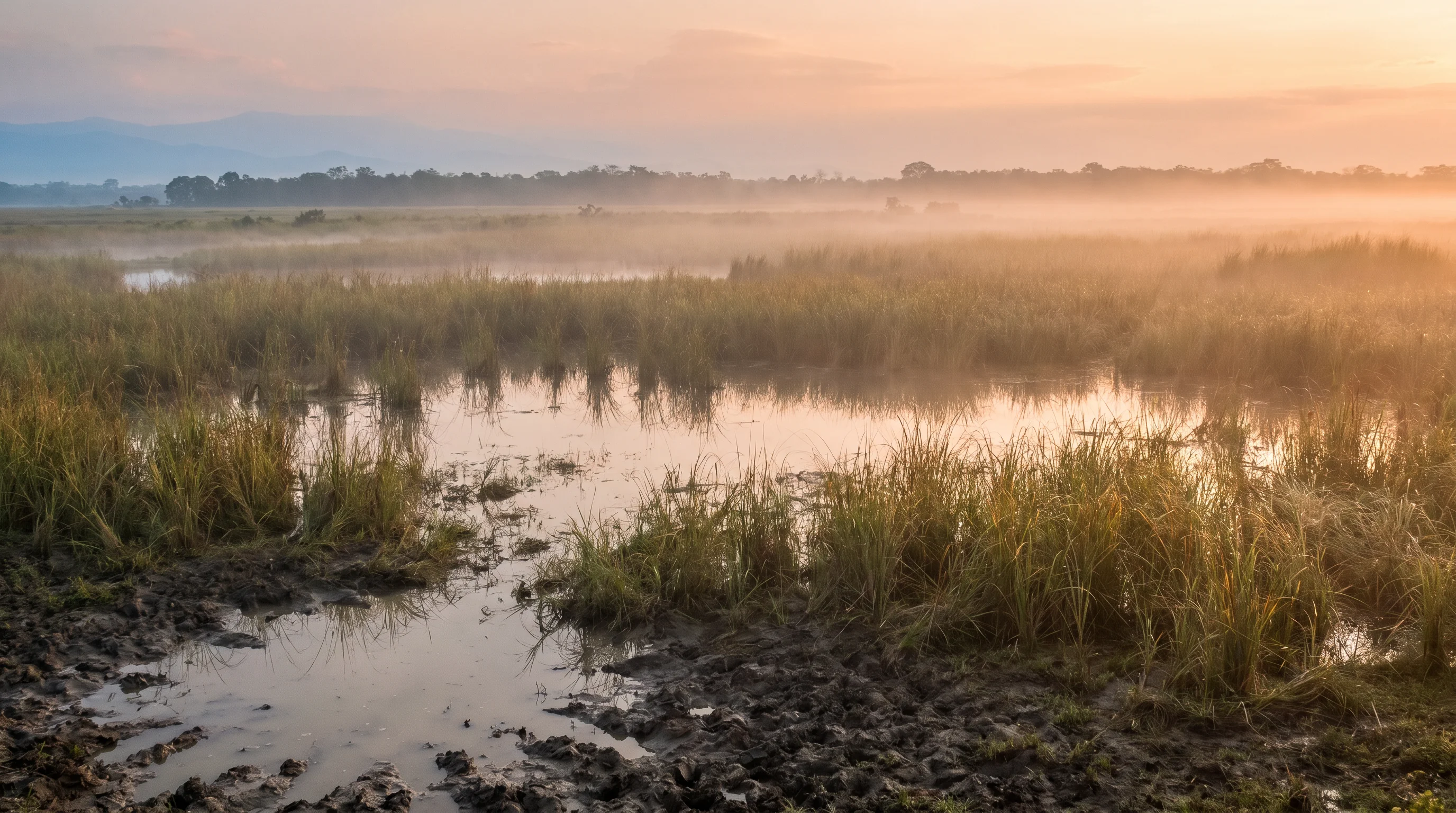
Water buffalo are now mostly a domesticated animal, spread by people across Asia, Africa, Europe, South America, and Australia. The wild ancestor belongs to South and Southeast Asian wetlands, where true wild herds now survive only in scattered places such as Assam and Chhattisgarh in India, Koshi Tappu and Chitwan in Nepal, Bhutan, Thailand, and Cambodia. Feral herds also live in places people introduced them, including northern Australia and Indonesia's Komodo and Flores islands.
The range
Five regions, one species.
The water buffalo doesn't live in one place. Across the map below, each region has its own pressures, prey, and politics — same biology, different worlds.
-
Indonesia
Komodo National Park
Feral swamp-buffalo-ancestry population. Ariefiandy et al. (2013) recorded the species on Komodo and Rinca but at lower density than rusa deer or feral pig. Primary nemesis range for Ora (B3 / Komodo Dragon). Locked Komodo NP sympatry.
Source ↗ -
Indonesia
Flores (Wae Wuul Nature Reserve)
Wae Wuul Nature Reserve on Flores held the highest buffalo faecal density (606.6 faeces/ha) among the study sites — an important extension of the Komodo NP prey system onto Flores proper.
Source ↗ -
Indonesia
Timor
Long-standing feral swamp-buffalo population on Timor — one of the Lesser Sunda Island feral populations that seeds the regional stock and ecologically parallels the Komodo NP population.
Source ↗ -
Australia
Northern Territory (Kakadu and Arnhem Land floodplains)
Swamp-type buffalo introduced to the Cobourg Peninsula in the 1820s by British colonies and subsequently gone feral across Top End floodplains. ADW documents the Australian feral herd structure (adult females, offspring, sub-adult females) used as the reference for feral social behaviour.
Source ↗ -
Brazil
Pantanal and Amazon floodplains
Major South American domesticated-and-feral population; part of the ~1% of the global buffalo population that sits outside Asia. Included as a geographic breadth anchor.
Source ↗
Daily life
What the water buffalo does, day to day.
Diet, social behaviour, climate — the everyday biology that shapes how this species hunts, defends and survives.
-
Diet
Obligate grazer and ruminant. Primary diet is grass, sedges, and aquatic vegetation — reeds, water hyacinth, submerged marsh grasses, water lilies — plus herbs, leaves, and agricultural crops where available.
-
Social life
Gregarious and matriarchal. Wild and feral herds typically number 10–20 individuals — mixed adult females, their offspring, and sub-adult females — with larger aggregations of up to 100 documented at shared water sources.
-
Climate
Tropical and subtropical. Obligate water-and-wallowing dependence: the species has sparse hair and few functional sweat glands, so thermoregulation relies on mud-wallowing and submersion rather than evaporative cooling.
Wyld Trivia
Five questions. Most people get them wrong.
But you're not most people.
Tap to reveal.
-
Were there two buffalo family trees from the start?
Show me HideYes. Domestic water buffalo split into two types: river buffalo (curled horns, larger, mostly milk) and swamp buffalo (swept-back horns, smaller, mostly ploughing). Y-chromosome studies show their split happened BEFORE humans domesticated either one — they descend from two different ancestral wild populations. Humans didn't create the difference. We just tamed both branches separately. Modern Asian buffalo aren't river-swamp hybrids; the deep split came first, any later mixing came second.
-
Is mud like a cooling jacket for a buffalo?
Show me HidePretty much. Water buffalo have very dark skin that absorbs lots of solar heat, plus weak sweating compared to cows. Wallowing in mud or water is how they dump that heat — not just a cute habit. A 2010 review treats wallowing as a key heat-control behaviour: the wet layer evaporates from the skin and pulls heat out. Without water and mud, buffalo overheat fast above about 35°C.
-
How can a huge animal become hard to find?
Show me HideWild Asian water buffalo are not doing fine. Bubalus arnee — the wild ancestor of all 200 million domestic water buffalo — is classified Endangered by the IUCN. A 2021 mitochondrial-genome study described the remaining wild populations as small, fragmented across India, Nepal, Bhutan, Thailand, and Cambodia, and at risk from hybridisation with feral domestic buffalo. The tame form took over the world. The wild form is slipping toward extinction.
-
How can one giant lizard beat an animal bigger than itself?
Show me HideKomodo dragons attack large prey with a single deep bite, then retreat to track the victim. Fry et al. 2009 showed the dragon delivers complex venom — anticoagulants and pressure-dropping toxins — that can cause shock and collapse. The old story about killer mouth-bacteria is wrong. Adult water buffalo that avoid that pressure crash often survive the initial bite and return to the herd. The kill isn't instant. The dragon waits and tracks.
-
Why would a buffalo need mud more than sweat?
Show me HideBecause their skin can't sweat well enough to cool them. A 1955 study compared the skin of Egyptian buffalo and cattle and showed buffalo have FEWER sweat glands than cattle — sweating is a much weaker cooling tool for them. That's why external cooling with water or mud matters so much. It's not preference. It's anatomy. The mud does what their skin can't.
The terrain
Where the water buffalo thrives.
Every animal is built for some places more than others. These are the ground, hours and weather where this species shows its best — and its worst.
Ground
- Wetland Excels
- Riparian Excels
- Grassland Strong
- Savanna Strong
- Dense forest Average
- Dry scrub Struggles
- Mountain Avoids
Hours
- Dawn Excels
- Dusk Excels
- Twilight Excels
- Night Strong
- Day Struggles
Weather
- Moderate Excels
- Rain Strong
- Wind Average
- Storm Average
- Hot Struggles
- Cold Avoids
Five things you didn't know about the water buffalo.
Cited biology that shapes how the water buffalo feeds, defends, survives.
-
The domesticated water buffalo splits into two morphologically and cytogenetically distinct subtypes: river buffalo (2n=50, larger at 450–1,000 kg, curled horns, primarily dairy) and swamp buffalo (2n=48, smaller at 325–450 kg, swept-back horns, primarily draft). Both descend from the wild Asian buffalo Bubalus arnee — river-type domesticated ~6,300 years ago in northwestern India, swamp-type domesticated 3,000–7,000 years ago near the China–Indochina border. Source ↗
-
The global water buffalo population is estimated at around 208 million head across 77 countries — more than 98% in Asia — making the species the most important domesticated bovid across tropical and subtropical agriculture, providing draft power, meat, and 15% of the world's fresh-milk supply. Source ↗
-
On the Komodo National Park islands, water buffalo are one of three introduced ungulate species (alongside rusa deer and feral pig) that dominate the adult Komodo dragon's diet. Ariefiandy et al. (2013) recorded buffalo on four sites across Komodo, Rinca, and the Wae Wuul Nature Reserve on Flores; they were absent from the smaller dragon-bearing islands of Gili Motang and Nusa Kode and consistently less abundant than deer or pigs. Source ↗
-
Komodo dragons (Varanus komodoensis) attack large prey such as water buffalo with a single deep slashing bite and then retreat to track the victim. Fry et al. (2009, PNAS) showed the dragon delivers a complex venom containing anticoagulant phospholipase A2 plus hypotensive kallikrein, CRISP, and natriuretic peptides — producing shock, pressure drop, and collapse rather than bacterial sepsis. Adult buffalo that avoid dropping from hypotension often survive the initial bite and return to the herd. Source ↗
-
Water buffalo are the most aquatic of all cattle, with wide splayed hooves, flexible fetlocks, and buoyant subcutaneous fat that let them swim strongly and submerge with only nostrils and eyes exposed. Adults routinely wallow for hours during midday heat and can cross open water between islands — behaviour central to their semi-aquatic niche in Komodo National Park's floodplain and mangrove fringes (Animal Diversity Web). Source ↗
About the water buffalo
Where the water buffalo sits on the tree of life.
-
Class
Mammalia
Warm-blooded animals with fur or hair that feed their young milk.
-
Order
Artiodactyla
Hoofed mammals with an even number of toes — pigs, deer, cattle.
-
Family
Bovidae
A family of related species — Bovidae.
-
Species
Bubalus bubalis
Water Buffalo — the species this page is about.


Water Buffalo
Every fact, cited.
Biology cited on this page comes from peer-reviewed zoology and the major species databases. Click through for the underlying study, dataset or assessment.
- frontiersin.org · frontiersin.org
- fao.org · fao.org
- Wiley · Wiley
- pnas.org · pnas.org
- Animal Diversity Web · Animal Diversity Web


