
Asiatic Black Bear
Scientific name Ursus thibetanus
Adult size
- Weight
- ♀F 50-125 kg ♂M 100-200 kg
- Length
- ♀F 1.55 m ♂M 1.55 m
- Shoulder height
- ♀F 0.7-1 m ♂M 0.7-1 m
- Top speed charge
- ♂M 50 km/h
- Lifespan
- Wild lifespan can reach around 25 years, with maximum longevity records passing 30 years.
Represented by Tashi Jigme Dorji National Park, Bhutan

Asiatic black bears - moon bears - live in forested mountains and hills across 18 Asian countries, from south-eastern Iran and Pakistan through the Himalayas of India, Nepal, Bhutan, and Bangladesh, then east through Myanmar, Thailand, Laos, Cambodia, Vietnam, China, Korea, Japan, and the Russian Far East. In Bhutan they are recorded widely, including high mountain protected landscapes such as Jigme Dorji National Park.
Where they live
Three angles, one home.
The asiatic black bear represented in the Wyld Savage League lives in Jigme Dorji National Park, Bhutan. Three views of the same patch of country — at ground level, from above, and bird's-eye.
-
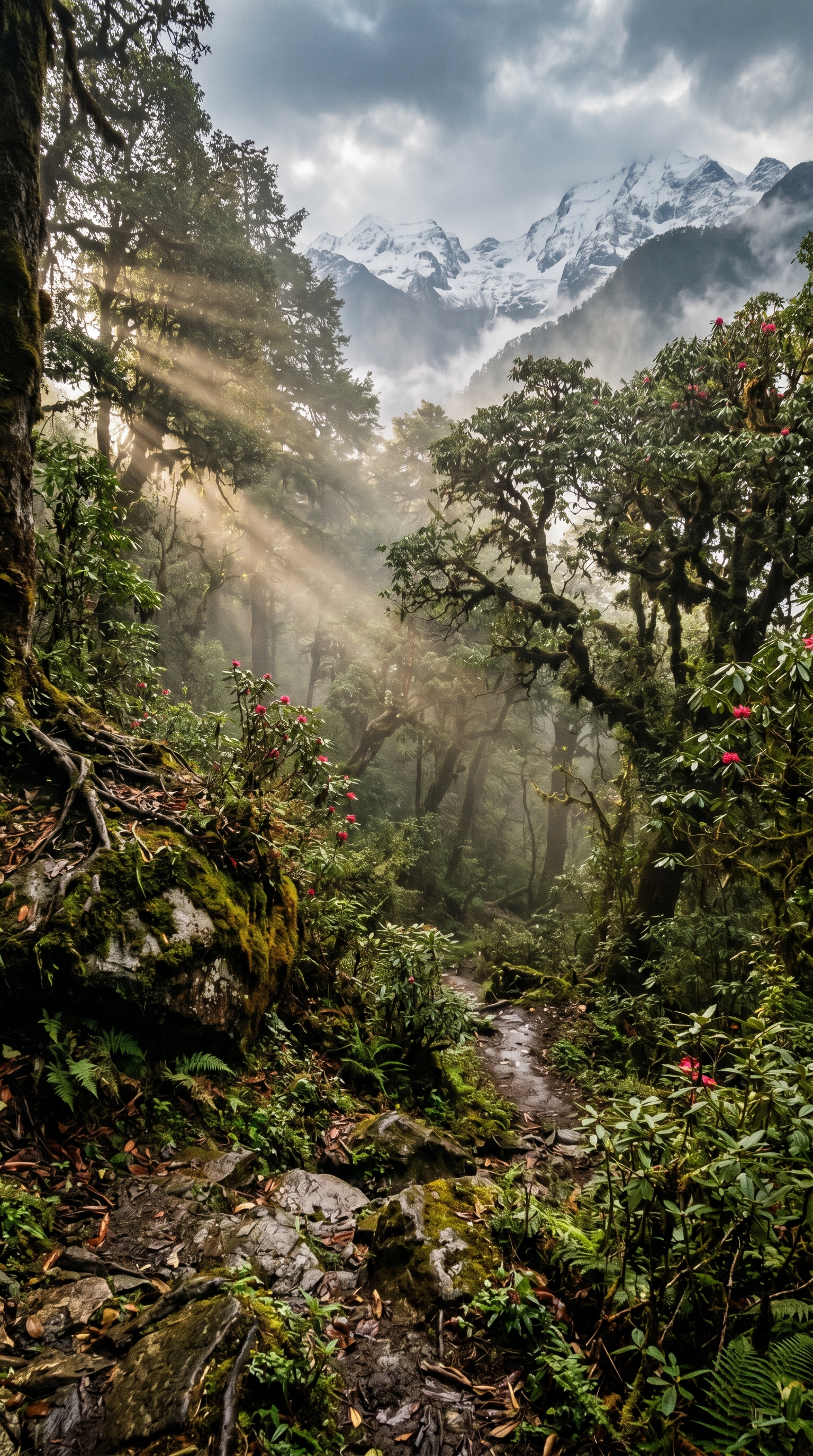
Bhutanese mid-altitude forest at ground level — oak and rhododendron mast where moon bears feed in autumn. -
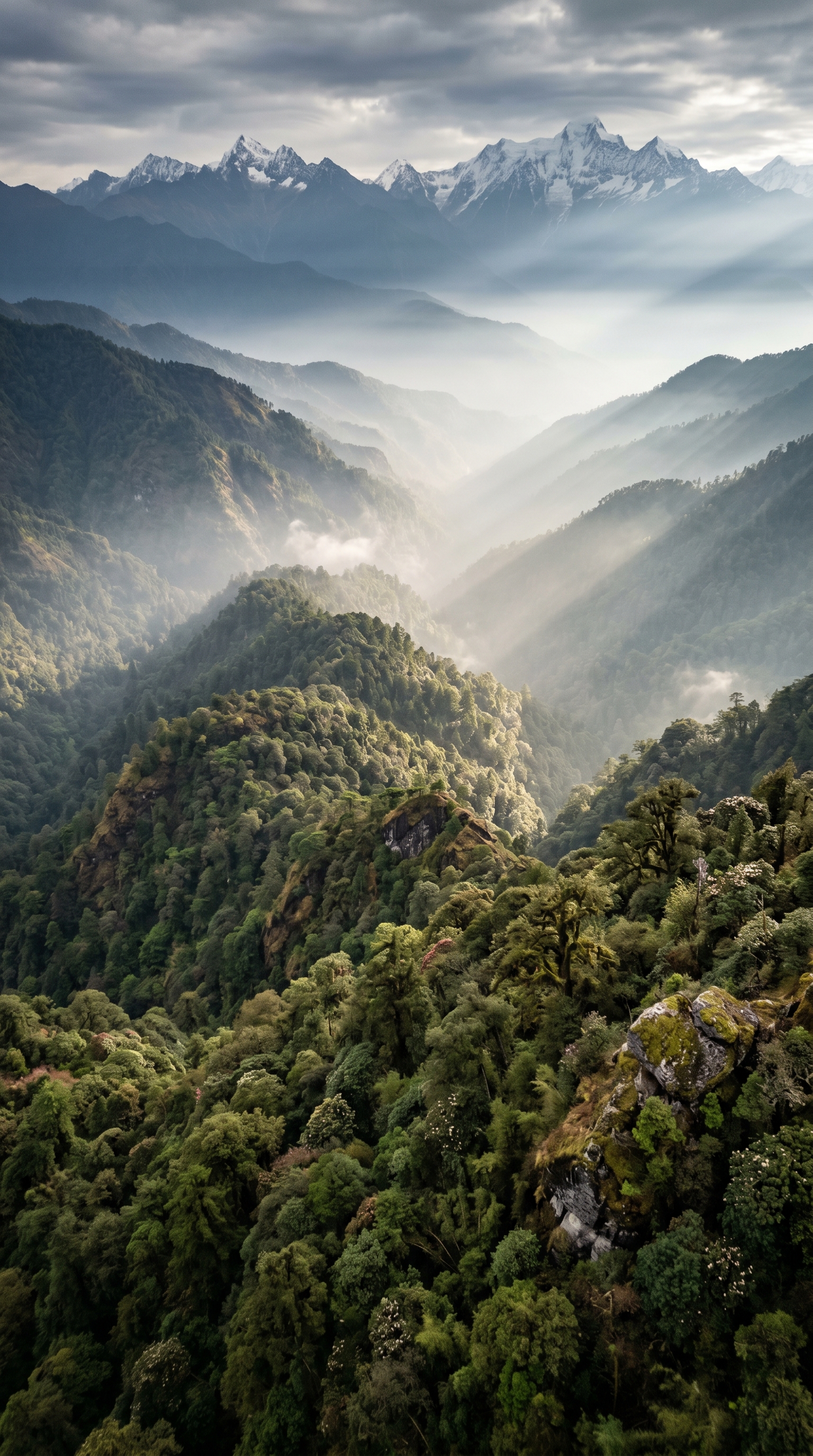
Jigme Dorji's wooded ridges from above — a mosaic of forest and alpine pasture across Bhutan's central highlands. -
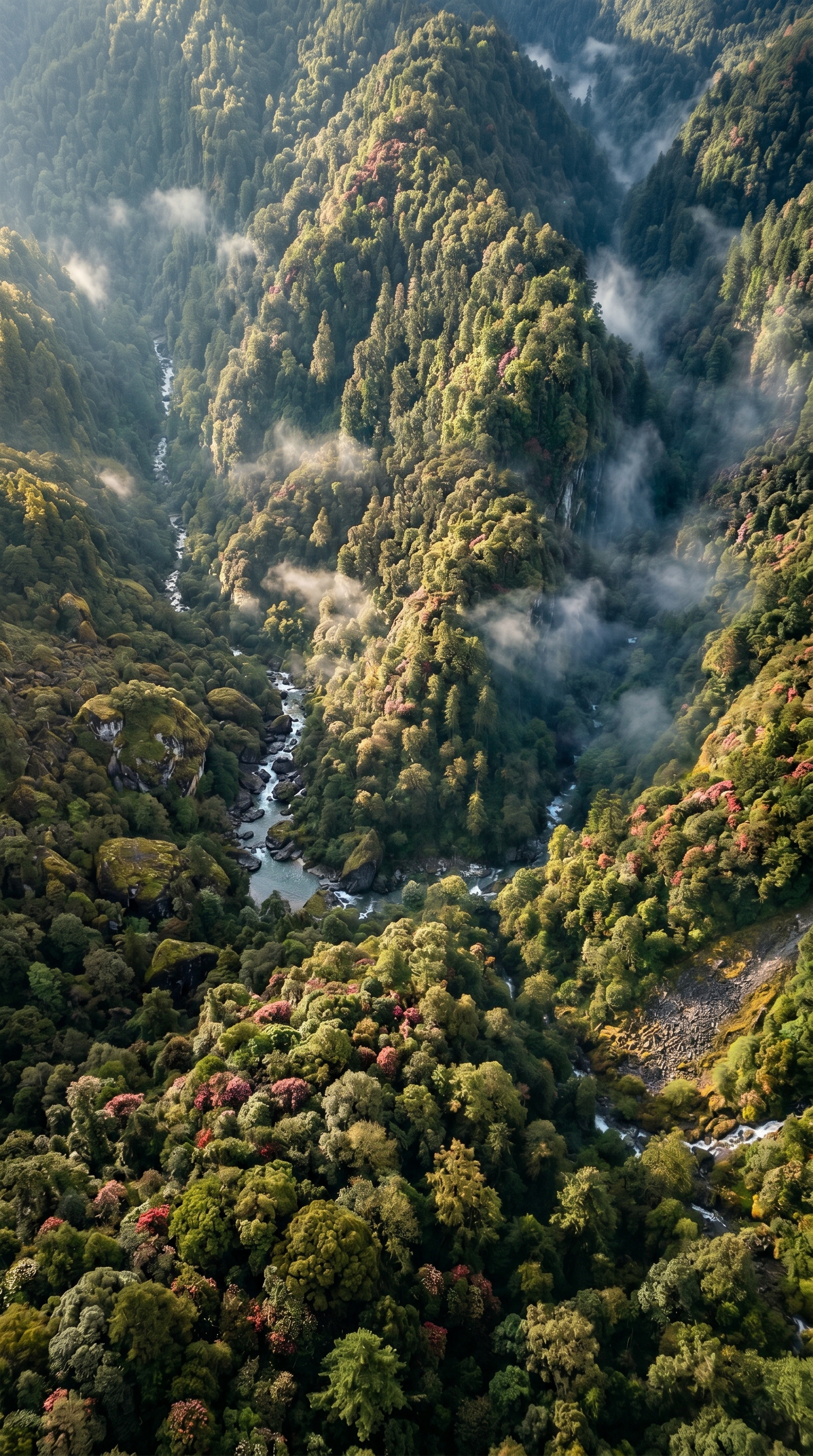
Asiatic black bear country from high overhead — the eastern Himalayas, from Pakistan through to Vietnam.
Native range
Asiatic black bears - moon bears - live in forested mountains and hills across 18 Asian countries, from south-eastern Iran and Pakistan through the Himalayas of India, Nepal, Bhutan, and Bangladesh, then east through Myanmar, Thailand, Laos, Cambodia, Vietnam, China, Korea, Japan, and the Russian Far East. In Bhutan they are recorded widely, including high mountain protected landscapes such as Jigme Dorji National Park.
The range
Eight regions, one species.
The asiatic black bear doesn't live in one place. Across the map below, each region has its own pressures, prey, and politics — same biology, different worlds.
-
Bhutan
Jigme Dorji National Park
Tashi's home territory. Bhutan's action plan records Asiatic black bears widely in the country and names Jigme Dorji National Park as a human-bear conflict area; use species-level Bhutan context rather than an exact local stat line.
Source ↗ -
Bhutan
Royal Manas National Park
Southern Bhutan protected-area context; keep as Bhutan range context, not a special Royal Manas biometric line.
Source ↗ -
Nepal
Sagarmatha (Everest) National Park
High-altitude Himalayan population. Core range for U. t. laniger.
Source ↗ -
India
Uttarakhand Western Himalayas
Fragmented protected-area populations; sympatric with Bengal tigers and Indian leopards (Panthera pardus fusca).
Source ↗ -
China
Sichuan Province
Part of China's ~28,000 global total (largest national population). Qinling Mountains stronghold.
Source ↗ -
China
Wolong National Nature Reserve (Sichuan)
Panda-zone sympatry. Wolong NP is China's flagship Giant Panda reserve and co-hosts a documented Asiatic Black Bear population across the same 1,200–3,400 m bamboo-forest elevation band (Hull et al. 2015 peer-reviewed carnivore-community structure work at Wolong). Competitive overlap with Giant Panda on bamboo shoots, fruit, and mid-elevation forest habitat; bears are seasonal competitors for mast-bearing oak and bamboo flowering events. Bāo (Group F2) nemesis terrain.
Source ↗ -
Russia
Primorsky Krai
5,000–7,000 individuals. Protected under Russian Red Data Book. Sympatric with Amur tigers — documented tiger predation on denning bears.
Source ↗ -
Japan
Honshū
Island endemic subspecies. Management protocols established 2000. Rare colour-variant individuals lacking white chest crescent (known as minaguro / munaguro).
Source ↗
Daily life
What the asiatic black bear does, day to day.
Diet, social behaviour, climate — the everyday biology that shapes how this species hunts, defends and survives.
-
Diet
Omnivore with highly seasonal, plastic diet. Spring: fresh vegetation, flowers, insect larvae.
-
Social life
Mostly solitary, with home ranges that vary widely by region, season, food, and sex.
-
Climate
Broadleaf and conifer forest from low hills to high mountains.
Wyld Trivia
Five questions. Most people get them wrong.
But you're not most people.
Tap to reveal.
-
Why is the Asiatic black bear nicknamed the 'moon bear'?
Show me HideBecause many have a pale crescent on the chest that looks like a little moon. The patch can be cream, white, or pale yellow, and it stands out sharply against the black fur.
-
How big can a male moon bear get?
Show me HideThe IUCN/IBA Bear Biology account lists adult males at 100 to 200 kilograms. Tashi is 140 kilograms, so he is a strong adult male without being outside the real range.
-
Why are trees so important to an Asiatic black bear?
Show me HideTrees hold fruit, nuts, shelter, and escape routes. Asiatic black bears have strong forelimbs, curved claws, and large heel pads that help them climb into the canopy.
-
What does a moon bear eat?
Show me HideA bit of almost everything, depending on the season: fresh plants, fruit, berries, insects, acorns, beechnuts, walnuts, eggs, carrion, and sometimes crops near farms.
-
How high in Bhutan can moon bears live?
Show me HideBhutan's national action plan records Asiatic black bears from low southern forests to more than 5,000 metres in the northern mountains, with temperate forests in central and western Bhutan especially important.
The terrain
Where the asiatic black bear thrives.
Every animal is built for some places more than others. These are the ground, hours and weather where this species shows its best — and its worst.
Ground
- Temperate forest Excels
- Coniferous forest Excels
- Rocky mountain Strong
- Bamboo understory Strong
- Grassland Struggles
- Open Avoids
Hours
- Dawn Excels
- Dusk Excels
- Twilight Excels
- Night Strong
- Day Struggles
Weather
- Moderate Excels
- Cold Strong
- Rain Average
- Wind Average
- Storm Struggles
- Hot Avoids

Five things you didn't know about the asiatic black bear.
Cited biology that shapes how the asiatic black bear feeds, defends, survives.
-
The pale chest crescent - cream, white, or pale yellow against black fur - is why the species is often called the moon bear. Source ↗
-
Adult males are listed at 100-200 kg by the IUCN/IBA Bear Biology account; Tashi's 140 kg character weight sits safely inside that range. Source ↗
-
Adults are typically 70-100 cm tall on all fours. Source ↗
-
Asiatic black bears are strong climbers with curved claws up to about 5 cm, strong forelimbs, and large heel pads; they climb trees for fruit, nuts, and resting places. Source ↗
-
Bhutan's national action plan records Asiatic black bears across the country and names Jigme Dorji National Park as one of the places where human-bear conflict has been reported. Source ↗
About the asiatic black bear
Where the asiatic black bear sits on the tree of life.
-
Class
Mammalia
Warm-blooded animals with fur or hair that feed their young milk.
-
Order
Carnivora
Mostly meat-eating mammals — cats, dogs, bears and their relatives.
-
Family
Ursidae
The bear family — large, strong, mostly omnivorous.
-
Species
Ursus thibetanus
Asiatic Black Bear — the species this page is about.


Asiatic Black Bear
Every fact, cited.
Biology cited on this page comes from peer-reviewed zoology and the major species databases. Click through for the underlying study, dataset or assessment.
- bearbiology.org · bearbiology.org
- bearbiology.org · bearbiology.org
- bearbiology.org · bearbiology.org
- worldlandtrust.org · worldlandtrust.org
- bearbiology.org · bearbiology.org
- bfl.org.bt · bfl.org.bt


