
Spectacled Bear
Scientific name Tremarctos ornatus
Adult size
- Weight
- ♀F 60 kg ♂M 140 kg
- Length
- ♀F 1.45 m ♂M 1.65 m
- Shoulder height
- ♀F 0.65 m ♂M 0.76 m
- Top speed charge
- ♂M 40 km/h
- Lifespan
- Spectacled Bears are thought to average about 20 years in the wild; captive records can reach about 36.7 years.
Represented by Misti Manu National Park, Peru

Spectacled bears, also called Andean bears, live only along the Andes of South America, from Venezuela through Colombia, Ecuador, Peru, and Bolivia, with rare edge records farther south. They climb through cloud forest, upper mountain forest, Polylepis woodland, dry valleys, and high paramo and puna grasslands. Paramo and puna are cold, open, high-altitude grasslands above much of the forest.
Where they live
Three angles, one home.
The spectacled bear represented in the Wyld Savage League lives in Manu National Park, Peru. Three views of the same patch of country — at ground level, from above, and bird's-eye.
-
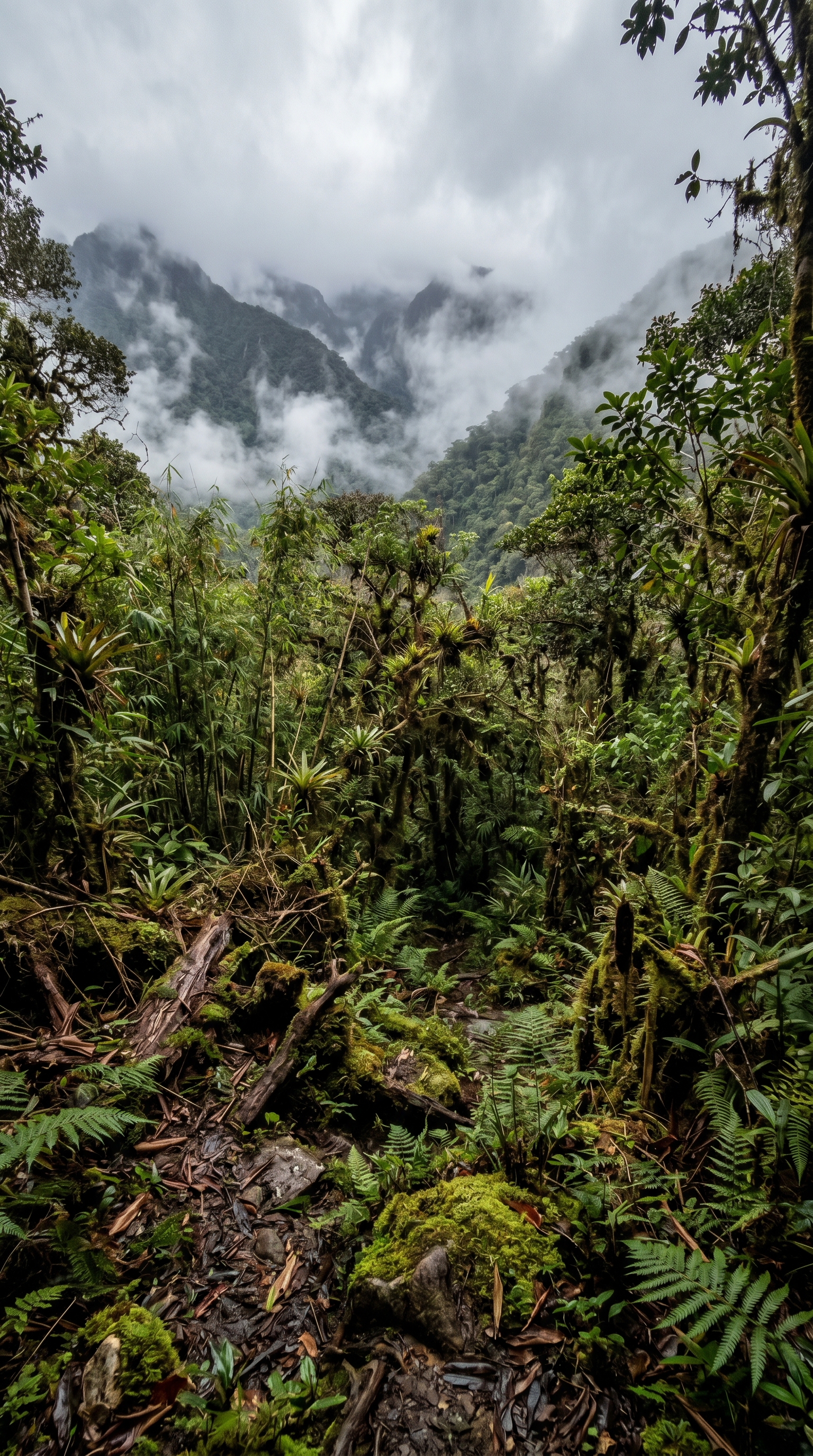
Manu National Park, Peru at ground level — home of the spectacled bear. -
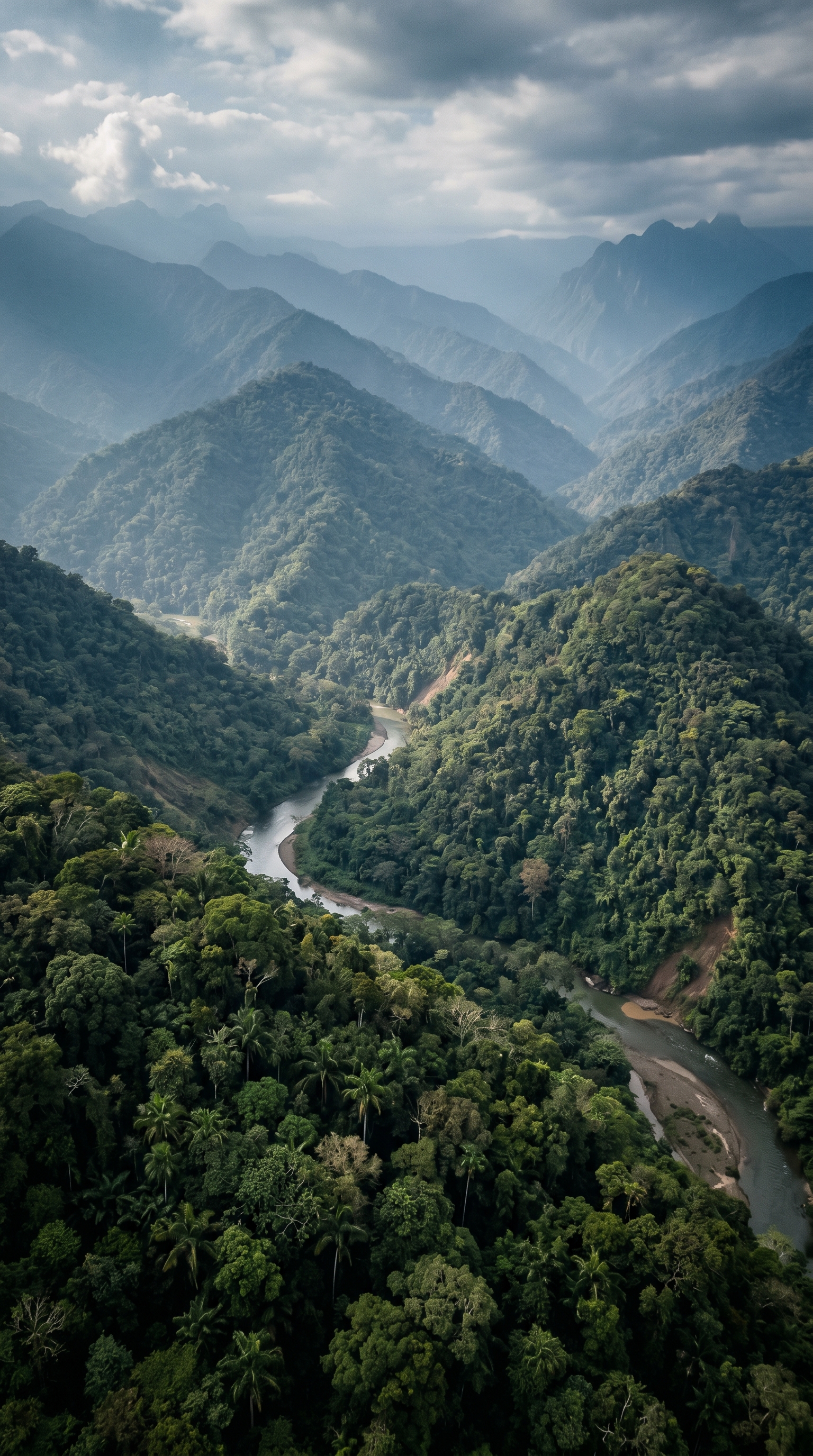
Manu National Park, Peru seen from above — home of the spectacled bear. -
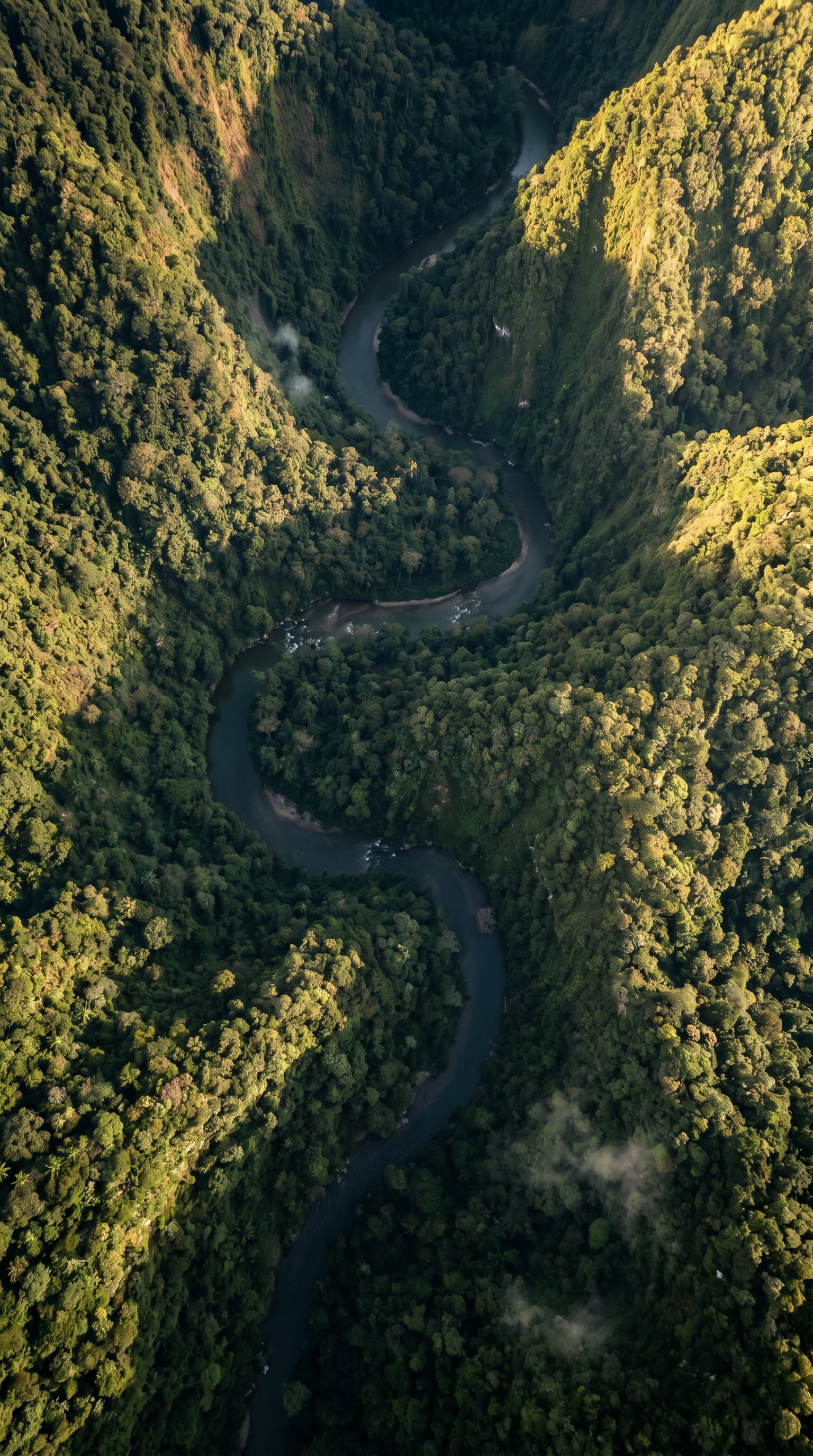
Manu National Park, Peru from high overhead — home of the spectacled bear.
Native range
Spectacled bears, also called Andean bears, live only along the Andes of South America, from Venezuela through Colombia, Ecuador, Peru, and Bolivia, with rare edge records farther south. They climb through cloud forest, upper mountain forest, Polylepis woodland, dry valleys, and high paramo and puna grasslands. Paramo and puna are cold, open, high-altitude grasslands above much of the forest.
The range
Six regions, one species.
The spectacled bear doesn't live in one place. Across the map below, each region has its own pressures, prey, and politics — same biology, different worlds.
-
Peru
Manu National Park
Core Peruvian stronghold — cloud-forest belt on the eastern Andean flank (elevations ~300–4,020 m). One of the most biodiverse protected areas on Earth; candidate home territory for Misti.
Source ↗ -
Ecuador
Sangay National Park
UNESCO World Heritage site spanning eastern Andean cordillera. Andean bears occur across the full elevational gradient from cloud forest to páramo.
Source ↗ -
Colombia
Sierra Nevada de Santa Marta
Isolated coastal massif rising from sea level to 5,700 m — Andean bears occupy cloud-forest and montane habitat on the southern slopes. Genetically distinctive sub-population.
Source ↗ -
Bolivia
Madidi National Park
Elevations 180–6,000 m across Amazon-Andean transition. Andean bear population documented across yungas cloud-forest belt.
Source ↗ -
Venezuela
Yacambú National Park
Northernmost stronghold of the species range; small, fragmented Venezuelan population faces high conflict pressure.
Source ↗ -
Ecuador
Podocarpus National Park
Southern Ecuadorian Andes. Cloud-forest and páramo habitat at 900–3,600 m.
Source ↗
Daily life
What the spectacled bear does, day to day.
Diet, social behaviour, climate — the everyday biology that shapes how this species hunts, defends and survives.
-
Diet
Predominantly herbivorous — plant matter accounts for up to 90% of intake, making Tremarctos ornatus one of the most herbivorous extant ursids.
-
Social life
Solitary except for mother–cub units. Cubs remain with their mother approximately 6–8 months through the first year and up to weaning.
-
Climate
Broadest elevational range of any bear species — documented from ~200 m in lowland dry and moist forest to ~4,750 m in high páramo grassland and puna.
Wyld Trivia
Five questions. Most people get them wrong.
But you're not most people.
Tap to reveal.
-
Which is the only bear that lives in South America?
Show me HideThe spectacled bear, also called the Andean bear. It lives along the Andes mountains from Venezuela down through Colombia, Ecuador, Peru, and Bolivia. It's the only bear species on the entire South American continent. Because it lives in the tropics, it does not spend months hibernating like many northern bears.
-
Where does the spectacled bear get its name?
Show me HideFrom the pale rings around its eyes that look like spectacles or eyeglasses. Every bear has a different pattern — some have full rings, some have curved crescents, some have almost nothing. The pattern is unique enough that scientists can identify individual bears just by their faces.
-
What's the highest a bear can live up a mountain?
Show me HideThe spectacled bear reaches up to 4,750 metres in the Andean páramo grasslands — the widest elevation range of any bear. The same species is found from 200 metres in dry coastal forest all the way up to alpine grassland just below where snow stays year-round.
-
What does a spectacled bear eat — and what's its strangest food?
Show me HideMostly plants. Up to 90% of the diet is vegetation. Their favourite food is the tough, fibrous heart of the bromeliad — a spiky pineapple-relative plant that grows in the Andes. They tear it apart with powerful jaws, gripping it with a thumb-like extra digit on the paw. Few other animals can eat it.
-
What giant bear once roamed the Americas — and is the spectacled bear the last of its kind?
Show me HideYes. The spectacled bear is the only living member of an ancient group called the short-faced bears. Its extinct cousins included giant bears such as Arctotherium in South America and Arctodus in North America. The spectacled bear is the smaller living survivor of that old bear branch.
The terrain
Where the spectacled bear thrives.
Every animal is built for some places more than others. These are the ground, hours and weather where this species shows its best — and its worst.
Ground
- Cloud forest Excels
- Montane forest Excels
- High grassland paramo Strong
- Dry forest Strong
- Rocky mountain Strong
- Bamboo understory Strong
- Lowland open Struggles
Hours
- Dawn Strong
- Day Strong
- Dusk Strong
- Twilight Strong
- Night Average
Weather
- Moderate Excels
- Rain Excels
- Cold Strong
- Wind Average
- Storm Struggles
- Hot Struggles

Five things you didn't know about the spectacled bear.
Cited biology that shapes how the spectacled bear feeds, defends, survives.
-
Tremarctos ornatus is the only surviving member of the short-faced bear subfamily Tremarctinae — a lineage once represented across the Americas by extinct giant short-faced bears such as Arctotherium in South America and Arctodus in North America. Its shorter face and strong chewing muscles help it process tough plant food. Source ↗
-
The distinctive pale facial markings — white, cream, or yellowish rings around the eyes and across the muzzle — are unique to each individual and can be used by field biologists as a visual identifier, comparable to fingerprints. Patterns vary from full 'spectacles' to partial crescents or, in some individuals, no markings at all, and may shift in shape and colour as the bear ages. Source ↗
-
Andean bears are highly arboreal — they construct platform nests of broken branches high in the canopy, used for feeding on fruiting trees, daytime resting, and escaping ground threats. Individuals have been recorded sitting in a single fruiting tree for multiple days, waiting for fruit to ripen. Source ↗
-
The species occupies the widest elevational range of any living bear — from ~200 m in lowland dry forest to ~4,750 m in high-Andean páramo and puna grassland. Core habitat is cloud forest between 1,900–2,350 m, but confirmed records span coastal desert, sub-montane forest, cloud forest, and tree-line páramo. Source ↗
-
Listed as Vulnerable on the IUCN Red List since 1982, with a decreasing population trend and an estimated global total above 20,000 individuals across Venezuela, Colombia, Ecuador, Peru, and Bolivia. The species is a recognised flagship for Andean cloud-forest conservation; habitat has been reduced by approximately 30% in two decades, driven by deforestation, fragmentation, and retaliatory killing for livestock and crop predation. Source ↗
About the spectacled bear
Where the spectacled bear sits on the tree of life.
-
Class
Mammalia
Warm-blooded animals with fur or hair that feed their young milk.
-
Order
Carnivora
Mostly meat-eating mammals — cats, dogs, bears and their relatives.
-
Family
Ursidae
The bear family — large, strong, mostly omnivorous.
-
Species
Tremarctos ornatus
Spectacled Bear — the species this page is about.


Spectacled Bear
Every fact, cited.
Biology cited on this page comes from peer-reviewed zoology and the major species databases. Click through for the underlying study, dataset or assessment.
- bearbiology.org · bearbiology.org
- bearbiology.org · bearbiology.org
- Animal Diversity Web · Animal Diversity Web
- Animal Diversity Web · Animal Diversity Web
- IUCN Red List · IUCN Red List


