
Clouded Leopard
Scientific name Neofelis nebulosa
Adult size
- Weight
- ♀F 11.5 kg ♂M 20 kg
- Length
- ♀F 0.85 m ♂M 0.95 m
- Shoulder height
- ♀F 0.5 m ♂M 0.55 m
- Top speed
- ♀F 50 km/h ♂M 50 km/h
- Lifespan
- Clouded Leopards average about 11 years in the wild; captive records can reach about 17 years.
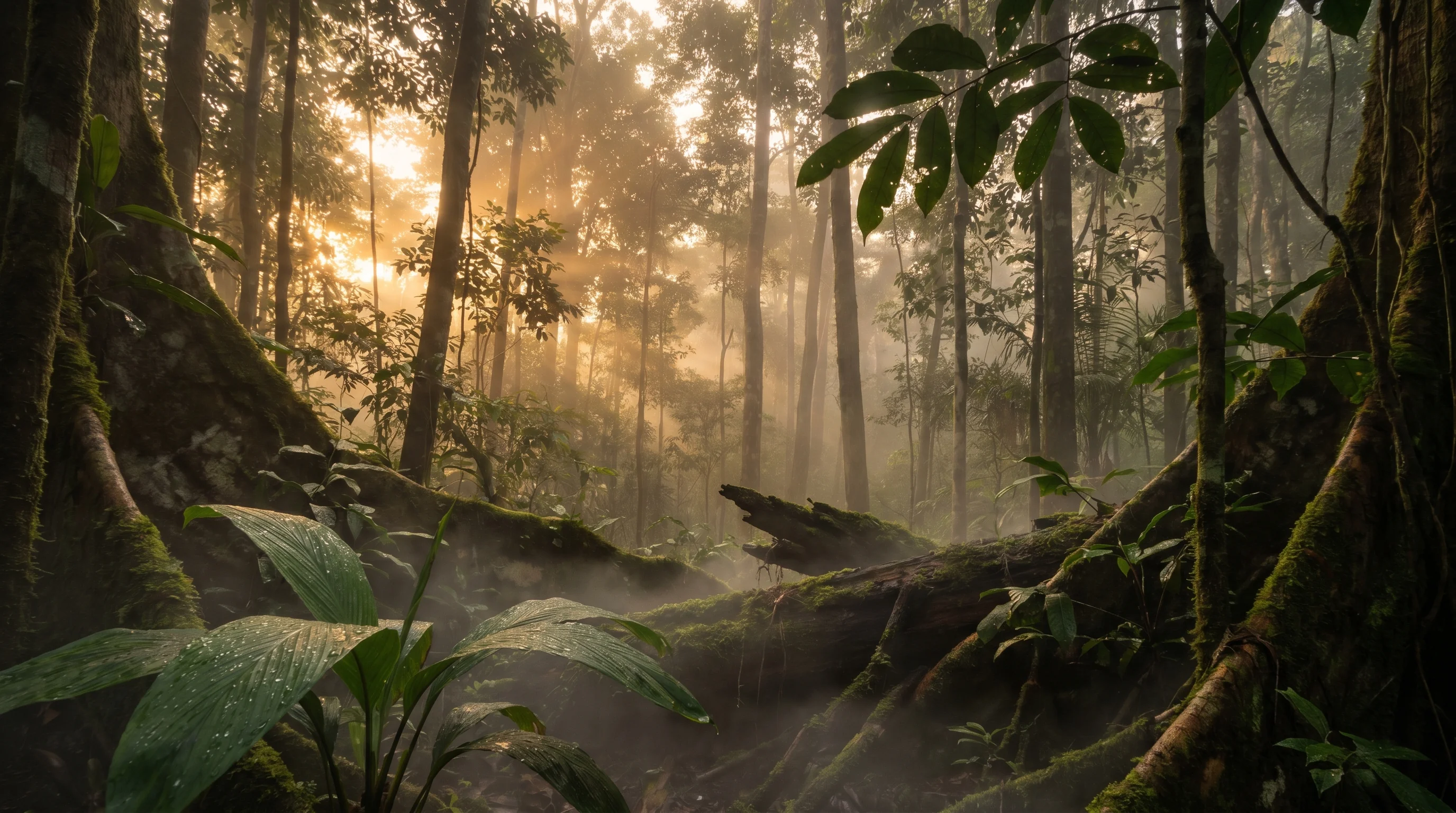
Mainland clouded leopards live in the forests of the eastern Himalayas and Southeast Asia: Nepal, Bhutan, north-east India, Bangladesh, southern China, Myanmar, Thailand, Laos, Cambodia, Vietnam, and Peninsular Malaysia. They need connected forest - lowland rainforest, mixed deciduous forest, bamboo, and mountain forest up to about 3,000 metres - because their whole body is built for branches, balance, and ambush in the canopy.
The range
Five regions, one species.
The clouded leopard doesn't live in one place. Across the map below, each region has its own pressures, prey, and politics — same biology, different worlds.
-
Bhutan
Royal Manas National Park
Himalayan-foothill tropical forest. Part of Bhutan's protected-area network; camera-trap confirmed alongside tiger and Asiatic black bear.
Source ↗ -
Thailand
Kaeng Krachan National Park
Tenasserim Range evergreen forest. One of Thailand's most-studied clouded-leopard populations via long-term camera-trap monitoring.
Source ↗ -
India
Manas National Park (Assam)
North-east Indian stronghold. Transboundary with Bhutan's Royal Manas NP — effectively a single continuous protected landscape.
Source ↗ -
Malaysia
Taman Negara National Park
Peninsular Malaysia lowland rainforest. Camera-trap confirmed. Sympatric with Malayan tiger, sun bear, and Asian water monitor.
Source ↗ -
Vietnam
Tam Dao National Park
Northern Vietnam montane forest. Populations severely threatened by snare-poaching; presence based on historical camera-trap and pelt records.
Source ↗
Daily life
What the clouded leopard does, day to day.
Diet, social behaviour, climate — the everyday biology that shapes how this species hunts, defends and survives.
-
Diet
Obligate carnivore. Opportunistic mid-sized apex predator.
-
Social life
Solitary. Adults associate only to mate. Mother-cub bond lasts approximately 9 months; cubs reach sexual maturity at 23–24 months.
-
Climate
Tropical and subtropical forest specialist. Primarily tropical evergreen rainforest, mixed deciduous forest, and montane forest up to 3,000 m elevation.
Wyld Trivia
Five questions. Most people get them wrong.
But you're not most people.
Tap to reveal.
-
Which living cat has the most sabre-tooth-like skull?
Show me HideThe clouded leopard. Christiansen 2006 measured cat skulls in detail. Among living cats, the clouded leopard's skull stands out — exceptionally long upper canines for its skull size, and a wide gape, like the extinct sabre-toothed cats. It's not direct ancestry. They aren't descended from sabre-tooths. It's convergent evolution. Different families. Same toolkit. Different times.
-
Are mainland and Borneo clouded leopards really the same animal?
Show me HideNot anymore. Buckley-Beason et al. 2006 found 36 fixed DNA differences between mainland clouded leopards (Neofelis nebulosa) and the ones on Borneo and Sumatra (Neofelis diardi). The genetic gap was in the same ballpark as the gap between lions and tigers. So in 2006, scientists split them into two species. Whole-genome work in 2022 confirmed it. They look similar. They live in different places. Their ancestors went separate ways millions of years ago.
-
How is a clouded leopard built for life in the trees?
Show me HideShort legs, broad paws, and a tail nearly as long as its body. Studies of paw-pad and hip anatomy (Hubbard 2009) show the clouded leopard's feet and limbs are designed for branch-gripping. In zoos, biologists HAVE seen them descend tree trunks head-first and hang upside-down from branches, supported by their hind feet. Wild documentation is rare — the species is so cryptic. The anatomy is real. The wild routine is harder to film.
-
How long ago did the two clouded leopard species split?
Show me HideAbout 5 million years ago — give or take. A whole-genome study (Bursell et al. 2022) puts the central estimate at 5.1 million years, with a credibility interval of 3.8 to 6.5 million. Older mtDNA-only studies estimated much younger splits (1.4 to 2.9 million). The split is solid. The exact date is model-dependent. Either way, the mainland and Sunda branches diverged long before any human walked Asia.
-
How are mainland clouded leopards doing in the wild?
Show me HideUnder pressure across most of their range. A 2020 study (Petersen et al., 'Strongholds under siege') used remote-sensing models to track the species' best-protected habitats. Modeled stronghold area shrunk by about 34% between 2000 and 2018. The IUCN classifies the species as Vulnerable, with population declining. Direct rangewide counts don't exist — the species is too cryptic for direct census. What we do have is consistent: habitat loss, fragmentation, and poaching across Southeast Asia, with many strongholds at high risk of local extinction.
The terrain
Where the clouded leopard thrives.
Every animal is built for some places more than others. These are the ground, hours and weather where this species shows its best — and its worst.
Ground
- Tropical rainforest Excels
- Montane forest Excels
- Mixed deciduous Strong
- Bamboo Strong
- River corridor Average
- Open grassland Avoids
- Desert Avoids
Hours
- Dusk Excels
- Night Excels
- Twilight Excels
- Dawn Strong
- Day Average
Weather
- Moderate Excels
- Hot Strong
- Rain Strong
- Wind Average
- Cold Struggles
- Storm Struggles
Five things you didn't know about the clouded leopard.
Cited biology that shapes how the clouded leopard feeds, defends, survives.
-
Clouded leopards have exceptionally long upper canines for their skull size among living cats. Christiansen (2006, Journal of Morphology) established that the species shares multiple craniomandibular features with extinct sabre-toothed felids (machairodontines such as Paramachairodus), including adaptations for an unusually wide gape. This represents convergent evolution, not direct ancestry — the clouded leopard's skull and gape morphology stand out strongly among living cats. The popular "longest canines of any living cat" line is a later simplification; the paper's actual point is comparative prominence among living cats, not an absolute superlative. Source ↗
-
The clouded leopard is one of the most arboreal of the larger cats — short legs, broad paws, and a tail near body length used for balance. Paw-pad and hip anatomy (Hubbard et al. 2009; Carlon & Hubbard 2012, both in The Anatomical Record) supports unusual climbing ability and branch-gripping. The famous "descends tree trunks head-first / hangs upside-down by its hind feet" framing rests largely on captive observations; strong wild mainland documentation of the specific behaviours is sparse because the species is cryptic and difficult to observe directly. The anatomy is well-evidenced; the wild routine is harder to film. Source ↗
-
Molecular analysis by Buckley-Beason et al. (2006, Current Biology) established that mainland clouded leopards (Neofelis nebulosa) and Sunda clouded leopards on Borneo and Sumatra (N. diardi) are separate species — not subspecies. The study identified 36 fixed mitochondrial and nuclear DNA differences and 20 non-overlapping microsatellite loci between the two populations, a genetic gap in the same ballpark as the gap between recognised Panthera species. Wilting et al. (2007, Frontiers in Zoology) and later whole-genome work (Bursell et al. 2022, iScience) confirmed and extended the split with morphology and genome-scale data. Source ↗
-
Whole-genome analysis (Bursell et al. 2022, iScience) places the divergence between mainland and Sunda clouded leopards at approximately 5.1 million years ago, with a 95% credibility interval of 3.8 to 6.5 million years. Earlier mtDNA-only estimates put the split much younger (1.4–2.9 Mya); the genome-scale point estimate is older but model-dependent. The species split itself is robust; the exact date is uncertain. Source ↗
-
Mainland clouded leopards are listed as Vulnerable on the IUCN Red List with population declining. A peer-reviewed range-wide stronghold analysis (Petersen et al. 2020, "Strongholds under siege", Global Ecology and Conservation) found modeled stronghold area declined by approximately 34% between 2000 and 2018, with high extirpation risk in many remaining strongholds. Direct rangewide counts of mature individuals are not available — the species is too cryptic for direct census. The literature anchors decline + fragmentation + extirpation risk across Southeast Asia, not a precise population total. Source ↗
About the clouded leopard
Where the clouded leopard sits on the tree of life.
-
Class
Mammalia
Warm-blooded animals with fur or hair that feed their young milk.
-
Order
Carnivora
Mostly meat-eating mammals — cats, dogs, bears and their relatives.
-
Family
Felidae
The cat family — solitary hunters with retractable claws.
-
Species
Neofelis nebulosa
Clouded Leopard — the species this page is about.


