
Dhole
Scientific name Cuon alpinus
Adult size
- Weight
- ♀F 11.5 kg ♂M 17.5 kg
- Length
- ♀F 0.88 m ♂M 0.95 m
- Shoulder height
- ♀F 0.45 m ♂M 0.5 m
- Top speed
- ♀F 48 km/h ♂M 48 km/h
- Lifespan
- Dholes can live about 10 years in the wild; captive records average about 16 years.
Dholes are Asia's whistle-hunting wild dogs. Today they survive in scattered populations across India, Nepal, Bhutan, Thailand, Myanmar, Laos, Cambodia, Vietnam, Malaysia, and Indonesia, with India holding the biggest share. Their old map was much wider, stretching into China, Korea, Central Asia, and the Russian Far East, but the modern range is less than a quarter of what it once was.
The range
Six regions, one species.
The dhole doesn't live in one place. Across the map below, each region has its own pressures, prey, and politics — same biology, different worlds.
-
India
Nagarhole National Park
Karnataka, Western Ghats. Karanth & Sunquist's long-running predator-coexistence study (tiger / leopard / dhole, 1986–1992) is the foundational peer-reviewed work on dhole pack ecology.
Source ↗ -
India
Kanha National Park
Madhya Pradesh, Central Indian Landscape. Core dhole stronghold; part of the Central Indian feeding-ecology dataset (Scientific Reports 2022).
Source ↗ -
India
Mudumalai Tiger Reserve
Tamil Nadu, Nilgiri Biosphere Reserve. Long-studied dhole population; sympatric with Bengal tiger and Indian leopard.
Source ↗ -
Thailand
Khao Yai National Park
Southeast Asian stronghold. Prey base dominated by sambar, muntjac, wild boar.
Source ↗ -
Bhutan
Royal Manas National Park
Lowland confirmed presence at 110 m — lowest elevation in Bhutan's dhole distribution. Transboundary with Manas Tiger Reserve, India.
Source ↗ -
Indonesia
Ujung Kulon National Park
Western Java. Southernmost dhole range; small, isolated, highly vulnerable.
Source ↗
Daily life
What the dhole does, day to day.
Diet, social behaviour, climate — the everyday biology that shapes how this species hunts, defends and survives.
-
Diet
Hyper-carnivorous pack hunter. Targets ungulates up to 10× individual body weight — sambar, chital, wild boar, gaur calves, barking deer, muntjac, hog deer, and (in Southeast Asia) banteng.
-
Social life
Obligately social, cooperatively breeding pack canid. Typical pack size 5–12 individuals; large "super-packs" of up to 28 documented at Navegaon-Nagzira Tiger Reserve (India) in low-tiger-density conditions.
-
Climate
Remarkable habitat plasticity. Occupies tropical and subtropical broadleaf forest, dry and moist deciduous forest, scrub steppe, montane mixed-conifer forest, and alpine meadow.
Wyld Trivia
Five questions. Most people get them wrong.
But you're not most people.
Tap to reveal.
-
Why is the dhole called the whistle hunter?
Show me HideMost wild dogs bark or howl. Dholes whistle. Their calls layer two pitches at once — high-frequency squeaks and low-frequency yaps in the same sound. These biphonic whistles probably help packs stay coordinated through dense forest where the dogs can't see each other, and captive studies suggest each whistle carries enough difference per dog that they can recognise each other by voice. The mechanism is unique among canids.
-
What do dhole packs hunt?
Show me HideMostly deer and wild pigs — and the exact mix shifts by place. In Central India, where dholes are best studied, sambar and chital deer are the core prey. In parts of Southeast Asia like Laos, smaller muntjac deer dominate instead. Dholes are fast eaters. A pack of two or three can dispatch a 50 kg deer in under two minutes, and they finish kills quickly so larger animals can't steal them.
-
What happens to dhole packs where tigers are common?
Show me HideThey get smaller. In a study across India's Eastern Vidarbha tiger landscape, dhole packs averaged about 17 individuals where tiger density was low — and about 6 where tigers were dense. Tigers are usually the dominant carnivore where they overlap with dholes; pack strength can sometimes soften that pressure but rarely flips it. The biggest dhole pack ever recorded — 28 dogs — was in light-tiger country. Big packs are not the species default.
-
How can the same dhole species live in cloud forest AND tropical jungle?
Show me HideRange. In Bhutan, dhole records run from 110 metres in lowland Royal Manas to 4,980 metres in alpine Jigme Dorji — almost 5 vertical kilometres of habitat. That's the highest elevation record for the species, and it overlaps directly with snow-leopard country. Per the Thinley 2021 study, dholes are the widest-distributed large carnivore in Bhutan — one species using lowland forest, mixed-conifer mountain slopes, and alpine meadow.
-
Why does a dhole have one fewer back tooth than a wolf?
Show me HideBecause dholes are pure meat-eaters. Wolves, coyotes, and domestic dogs all have three lower molars on each side. Dholes have only two — they've lost the back crushing tooth and kept sharper shearing teeth. The trade-off makes sense: dholes don't crunch bones the way wolves do, and they specialise in slicing meat off freshly-caught deer. Their teeth match what they actually eat.
The terrain
Where the dhole thrives.
Every animal is built for some places more than others. These are the ground, hours and weather where this species shows its best — and its worst.
Ground
- Tropical forest Excels
- Mixed deciduous Excels
- Montane forest Strong
- Alpine Strong
- Open grassland Average
- Dense bamboo Struggles
- Desert Avoids
- Steep rocky Avoids
Hours
- Dawn Excels
- Dusk Excels
- Twilight Excels
- Day Strong
- Night Average
Weather
- Moderate Excels
- Cold Strong
- Hot Strong
- Rain Strong
- Wind Average
- Storm Struggles
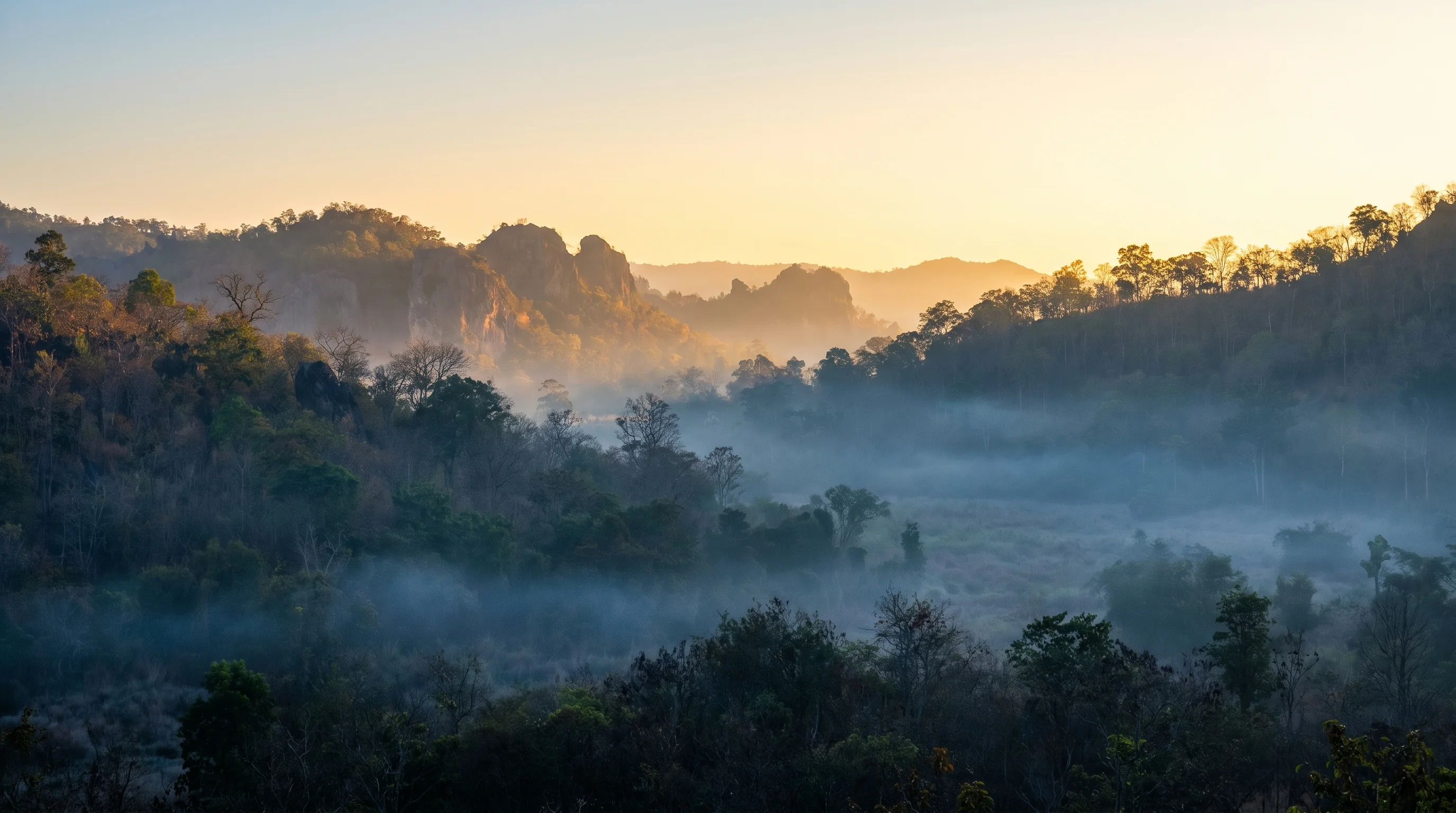
Five things you didn't know about the dhole.
Cited biology that shapes how the dhole feeds, defends, survives.
-
The dhole is listed as Endangered on the IUCN Red List (2015 assessment, Kamler et al.), with a global population estimated at 4,500–10,500 individuals and only 949–2,215 mature breeding adults. The species has contracted to less than 25% of its former 20th-century global range — one of Asia's rarest apex pack predators. Source ↗
-
Dholes possess one fewer molar on each side of the lower jaw than other canids — two lower molars per side versus three in wolves, coyotes, and domestic dogs. This reduced dentition is an adaptation to hyper-carnivory, trading crushing teeth for a shearing bite optimised for consuming large ungulates. Source ↗
-
Dholes are acoustic specialists among canids. Peer-reviewed analysis shows the pack's distinctive whistle combines high-frequency squeaks with low-frequency yaps into 'biphonic' calls. Captive studies (Volodina et al. 2006, Ethology; Durbin 1998, Bioacoustics) suggest these biphonic calls may help individuals recognise each other — supporting the species' 'whistle hunter' nickname and a likely role in pack coordination through limited-visibility forest. Wild communicative function is not yet fully tested. Source ↗
-
Pack size scales inversely with tiger density. In Maharashtra's Eastern Vidarbha Tiger Landscape, mean dhole pack size was 16.8 at the low-tiger-density Navegaon-Nagzira reserve (0.46 tigers/100 km²) versus 6.4 at high-tiger-density Tadoba-Andhari (5.36 tigers/100 km²). The largest documented super-packs — 28 individuals — form only where apex felid pressure is light. Source ↗
-
In Bhutan, dhole records span an unusually broad elevational range — from Royal Manas National Park at 110 m to Jigme Dorji National Park at 4,980 m, the highest reported elevational record for the species. Per Thinley et al. 2021, the dhole is the widest-distributed large carnivore in Bhutan, occupying everything from lowland tropical forest to alpine meadow that overlaps directly with snow-leopard habitat (3,400–5,186 m). Source ↗
About the dhole
Where the dhole sits on the tree of life.
-
Class
Mammalia
Warm-blooded animals with fur or hair that feed their young milk.
-
Order
Carnivora
Mostly meat-eating mammals — cats, dogs, bears and their relatives.
-
Family
Canidae
The dog family — pack-hunting, long-distance runners.
-
Species
Cuon alpinus
Dhole — the species this page is about.


Dhole
Every fact, cited.
Biology cited on this page comes from peer-reviewed zoology and the major species databases. Click through for the underlying study, dataset or assessment.
- IUCN Red List · IUCN Red List
- Animal Diversity Web · Animal Diversity Web
- doi.org · doi.org
- PubMed · PubMed
- frontiersin.org · frontiersin.org


