
Dingo
Scientific name Canis familiaris dingo
Adult size
- Weight
- ♀F 12.8 kg ♂M 15.6 kg
- Length
- ♀F 0.88 m ♂M 0.92 m
- Shoulder height
- ♀F 0.55 m ♂M 0.57 m
- Top speed
- ♀F 48 km/h ♂M 48 km/h
- Lifespan
- Dingoes can live up to about 10 years in the wild and about 13 years in captivity.
Dingoes live across mainland Australia and some offshore islands, from Kakadu's tropical savanna and wetlands to the Simpson and Great Victoria deserts, K'gari (Fraser Island), the Blue Mountains, and the Victorian Alps. The Dingo Barrier Fence cuts through the story: a 5,600 km fence built to keep dingoes out of sheep country in the south-east, leaving stronger wild populations on the unfenced side.
The range
Six regions, one species.
The dingo doesn't live in one place. Across the map below, each region has its own pressures, prey, and politics — same biology, different worlds.
-
Australia
Kakadu National Park (Northern Territory)
Tropical savannah and wetland dingo population in the Top End — sympatric with saltwater crocodile, frilled lizard, and emus. Representative Australian tropical-north stronghold.
Source ↗ -
Australia
Blue Mountains National Park (New South Wales)
Temperate sclerophyll forest and sandstone plateau population on the eastern seaboard.
Source ↗ -
Australia
K'gari (Fraser Island, Queensland)
Isolated island population of ~70–200 individuals with the most genetically distinct dingo lineage remaining, but significantly reduced effective population size (Ne 25.7) and inbreeding concerns. Domestic dogs prohibited on island to prevent hybridisation.
Source ↗ -
Australia
Alpine National Park (Victoria)
Temperate alpine and sub-alpine forest population in the Victorian high country — a genetically important southeastern stronghold.
Source ↗ -
Australia
Simpson Desert (Northern Territory / Queensland / South Australia)
Arid-zone population central to the Letnic et al. 2009 trophic-cascade study — demonstrates apex-predator role in suppressing red fox and feral cat populations across dune-field and gibber-plain country.
Source ↗ -
Australia
Sturt National Park (New South Wales)
Arid corner-country population at the NSW / SA / QLD junction. Pure dingoes persist across the Strzelecki / Sturt Stony Desert margins and red-earth gibber plains; NSW National Parks Service documents a stable wild-dog / dingo population inside the 310,000 ha park. The Dingo Barrier Fence runs along the park's northern boundary — Sturt NP sits on the unfenced side where wild dingoes maintain apex-predator function. Primary prey is red kangaroo (Osphranter rufus). Marlu-nemesis sympatry anchor (Group G1, Session 10).
Source ↗
Daily life
What the dingo does, day to day.
Diet, social behaviour, climate — the everyday biology that shapes how this species hunts, defends and survives.
-
Diet
Hyper-carnivorous opportunistic hunter. Australian populations consume roughly 60% mammalian prey with birds and reptiles making up the remainder: red and grey kangaroos, wallabies, wombats, rabbits, possums, rodents.
-
Social life
Packs of 3–12 individuals with a dominant alpha pair as the sole breeding unit — only the dominant female produces one annual litter.
-
Climate
Broad climatic tolerance. Thrives across hot arid interior (Simpson and Great Victoria Deserts), tropical north (Kakadu wetlands and tropical savannah), and temperate southeast (Alpine National Park, Blue Mountains).
Wyld Trivia
Five questions. Most people get them wrong.
But you're not most people.
Tap to reveal.
-
When did dingoes first arrive in Australia?
Show me HideAbout 3,300 years ago — and probably earlier. The oldest directly dated dingo bones come from Madura Cave on the Nullarbor Plain, radiocarbon-dated to between 3,348 and 3,081 years ago (Balme et al. 2018). Because the oldest firm bones are already from southern Australia, most researchers think dingoes actually arrived a bit earlier — often around 4,000 to 5,000 years ago. Either way, dingoes are old by human-recent-history standards, but new compared to native Australian mammals.
-
Are dingoes really just feral dogs?
Show me HideNo — modern genomics says they're their own thing. Weeks et al. 2024 (Evolution Letters) sampled 434 Australian canids and found dingoes remain a distinct, long-isolated lineage. They didn't detect population-level mixing with domestic dogs in their dataset. Cairns et al. 2023 found limited regional dog ancestry in some southeastern parts of Australia, but old percent-hybrid headlines (which used weaker genetic markers) likely overstated the problem. Closest known living relatives among the canids sampled so far are New Guinea Singing Dogs, not Labradors.
-
What happens to Australian wildlife when dingoes disappear?
Show me HideIt depends where you look. In some ecosystems, fewer dingoes are linked with more red foxes and feral cats, more kangaroos, and changes in small native mammals. But not every study agrees: a large-scale experimental dingo removal did NOT find the predicted mesopredator release. The dispute is not whether dingoes interact with prey and competitors. They do. The dispute is how often those interactions scale up into broad ecosystem cascades, especially under strong study designs.
-
Did dingoes really push thylacines off mainland Australia?
Show me HideMaybe — but not on their own. Mainland thylacines (Tasmanian tigers) went extinct around 3,000 years ago, soon after dingoes spread across the continent. Letnic et al. 2012 (PLoS ONE) argued that direct killing pressure by larger dingoes — especially on female thylacines — could plausibly explain the extinction. Other researchers (Johnson & Wroe 2003) point to multiple causes including growing human populations and environmental change. The dingo-only story doesn't survive the full evidence; dingoes may have contributed, but the mainland thylacine extinction isn't securely explained by one cause.
-
Why are island dingoes in trouble?
Show me HideTiny populations get genetically squeezed. K'gari (Fraser Island) holds one of Australia's most genetically distinct dingo populations — 70 to 200 animals. But the effective breeding population is just 25.7, about a quarter of mainland numbers (Conroy et al. 2021, Scientific Reports). That means low genetic diversity and detectable inbreeding. Miller et al. 2024 (Conservation Genetics) found that isolation, small population size, and culling-based management together drive the inbreeding pattern. Island dingoes are genetically priceless, but biologically fragile.
The terrain
Where the dingo thrives.
Every animal is built for some places more than others. These are the ground, hours and weather where this species shows its best — and its worst.
Ground
- Open outback Excels
- Arid scrubland Excels
- Savanna Strong
- Grassland edge Strong
- Woodland Average
- Wetland Average
- Dense rainforest Struggles
- Urban Struggles
Hours
- Dawn Excels
- Dusk Excels
- Twilight Excels
- Night Strong
- Day Struggles
Weather
- Moderate Excels
- Hot Strong
- Cold Average
- Rain Average
- Wind Average
- Storm Struggles
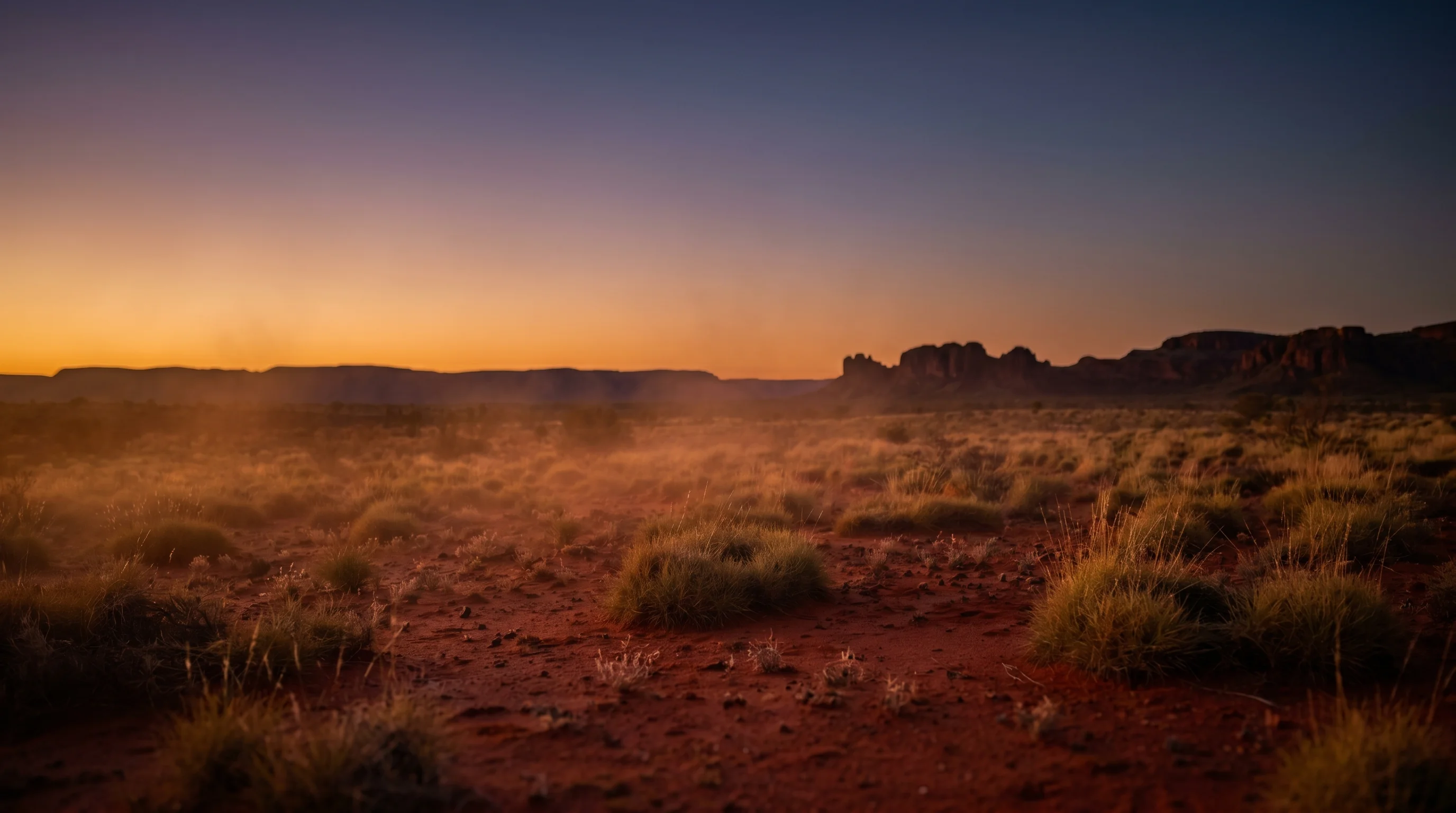
Five things you didn't know about the dingo.
Cited biology that shapes how the dingo feeds, defends, survives.
-
The oldest directly dated dingo bones in Australia come from Madura Cave on the Nullarbor Plain, radiocarbon-dated to approximately 3,348–3,081 cal BP (Balme et al. 2018, Scientific Reports). This is the oldest firm direct evidence, not the exact first-landing date — most researchers infer dingoes arrived in Australia somewhat earlier, often around 4,000–5,000 years ago. Recent ancient-genome work (Souilmi et al. 2024, PNAS) revealed over two thousand years of dingo population structure pre-European contact. Source ↗
-
Dingoes are mainland Australia's largest terrestrial predator. In some ecosystems, lower dingo abundance is linked with changes in herbivores, mesopredators, and small mammals. The strength of these effects is debated because some field comparisons report cascade-like changes, while a large-scale experimental top-predator removal trial did not find the predicted mesopredator release. Dingoes interact with prey and competitors; whether that reliably scales into broad ecosystem cascades remains contested under strong study designs. Source ↗
-
Mainland thylacines (Thylacinus cynocephalus) went extinct around 3,000 years ago, soon after dingoes spread across the continent. Letnic et al. (2012, PLoS ONE) argued that direct killing pressure by larger dingoes — especially on female thylacines — could plausibly explain the extinction. Johnson & Wroe (2003, The Holocene) argues for multiple causes including human population intensification and environmental change, and White et al. (2018, Biology Letters) added refined timing context. The dingo-only story does not survive the full evidence; dingoes may have contributed, but the mainland thylacine extinction is not securely explained by dingoes alone. Source ↗
-
The taxonomic rank of the dingo is actively contested across three positions: Canis dingo at species level (Smith et al. 2019, Zootaxa), Canis lupus dingo as a gray-wolf subspecies (historical IUCN treatment), and Canis familiaris dingo as a feral-type of the domestic dog (Jackson et al. 2017/2019, Zootaxa; followed by IUCN/SSC 2019 + American Society of Mammalogists 2020). Modern genome-wide work — Weeks et al. 2024 (Evolution Letters) and Cairns et al. 2023 (Molecular Ecology) — establishes that dingoes are a distinct, long-isolated canid lineage regardless of which Latin name a paper uses. Closest known living relatives among canids sampled so far are New Guinea Singing Dogs and related New Guinea highland wild dogs (Surbakti et al. 2020, PNAS). Source ↗
-
K'gari (Fraser Island) holds one of the most genetically distinct dingo populations in Australia, but is a demographic conservation concern — the isolated island population of 70–200 individuals has an effective population size (Ne) of just 25.7, roughly one-quarter of mainland dingo populations (Ne = 103.8), with significantly lower genetic diversity and detectable inbreeding (Conroy et al. 2021, Scientific Reports). Miller et al. (2024, Conservation Genetics) further documents how isolation, small population size, and culling-based management drive inbreeding and reduced genetic variation in K'gari dingoes — a population-level conservation concern that the IUCN's 2020 nomenclature change to Not Evaluated (after the species moved to Canis familiaris dingo) does not address. Source ↗
About the dingo
Where the dingo sits on the tree of life.
-
Class
Mammalia
Warm-blooded animals with fur or hair that feed their young milk.
-
Order
Carnivora
Mostly meat-eating mammals — cats, dogs, bears and their relatives.
-
Family
Canidae
The dog family — pack-hunting, long-distance runners.
-
Species
Canis familiaris dingo
Dingo — the species this page is about.


