
Sumatran Tiger
Scientific name Panthera tigris sondaica
Adult size
- Weight
- ♀F 91 kg ♂M 125 kg
- Length
- ♀F 2 m ♂M 2.3 m
- Shoulder height
- ♀F 0.7 m ♂M 0.75 m
- Top speed
- ♀F 60 km/h ♂M 60 km/h
- Lifespan
- Typical tiger wild lifespan is around 8-10 years, while captive lifespan is often around 16-18 years, with captive records up to 26 years.
The Sumatran tiger — the last surviving Sunda tiger — is endemic to the Indonesian island of Sumatra. The population is restricted to six main forest complexes and roughly 24 smaller landscape patches across about 88,000 km² of Tiger Conservation Landscapes, with around 58,000 km² of actually occupied forest habitat. The strongholds are the Leuser Ecosystem (north, including Gunung Leuser National Park and the Ulu Masen Ecosystem in Aceh), Kerinci Seblat National Park (central Sumatra — the single largest subpopulation), Bukit Barisan Selatan National Park (southern Lampung), Way Kambas National Park (eastern Lampung), and fragments across Riau (Tesso Nilo) and North Sumatra.…
The range
Five regions, one species.
The sumatran tiger doesn't live in one place. Across the map below, each region has its own pressures, prey, and politics — same biology, different worlds.
-
Indonesia
Gunung Leuser National Park
Gunung Leuser spans Aceh and North Sumatra provinces and is part of the Leuser Ecosystem — the only place on Earth where Sumatran tiger, Sumatran orangutan (Pongo abelii), and sun bear all overlap. Tiger densities of 1.42–2.35 per 100 km² documented in 2023–24 camera-trap surveys. Rimba (Group F3) home territory; apex nemesis terrain. Range-string normalised to bare 'Gunung Leuser National Park' for validator Rule 1 exact-match sympatry with sumatran-orangutan.md (Bialowieza precedent).
Source ↗ -
Indonesia
Bukit Barisan Selatan National Park
Southern Sumatra stronghold spanning Lampung / Bengkulu / South Sumatra provinces. Nine documented prey species >1 kg including Malayan tapir, sambar, muntjac, banded pig, and greater/lesser mousedeer. Sympatric with sun bear (*Helarctos malayanus malayanus*) — documented sun-bear predator per Nowell & Jackson 1996 (*Wild Cats* IUCN Status Survey) and Wong et al. Sumatran carnivore-community work. Range-string normalised to bare 'Bukit Barisan Selatan National Park' for validator Rule 1 exact-match sympatry with sun-bear.md and sumatran-orangutan.md (Gunung Leuser / Bialowieza precedent). Madu-nemesis sympatry anchor (Group G3, Session 10) — closes Sumatran Tiger cap at 2/2 alongside Rimba.
Source ↗ -
Indonesia
Kerinci Seblat National Park (Jambi / Sumatra Barat)
Largest protected area in Sumatra at 1.386 million hectares and the single largest Sumatran tiger subpopulation — 2020 park-wide surveys documented ~128 tigers across the park and surrounding forests, with 119 resident inside the park. Tiger encounter records have stabilised here, making it the most successful Sumatran tiger stronghold.
Source ↗ -
Indonesia
Way Kambas National Park (Lampung)
Eastern Sumatra lowland protected area. Island-wide survey reported 0.52 occupancy probability. Key lowland peat-swamp and freshwater-swamp forest habitat.
Source ↗ -
Indonesia
Tesso Nilo National Park (Riau)
Northern Riau landscape — lowest occupancy recorded (0.33) in the 2011 island-wide survey, correlating with the highest deforestation rate of any landscape assessed. Remnant but threatened.
Source ↗
Daily life
What the sumatran tiger does, day to day.
Diet, social behaviour, climate — the everyday biology that shapes how this species hunts, defends and survives.
-
Diet
Obligate carnivore. Primary prey: sambar deer (Rusa unicolor), wild boar (Sus scrofa), banded pig (Sus scrofa vittatus), Indian muntjac (Muntiacus muntjak), and greater and lesser mousedeer (Tragulus spp.
-
Social life
Solitary. Mother–offspring is the only persistent social bond; adults interact briefly for mating.
-
Climate
Equatorial tropical — hot, humid, year-round warm temperatures with high rainfall.
Wyld Trivia
Five questions. Most people get them wrong.
But you're not most people.
Tap to reveal.
-
Why is the Sumatran tiger the smallest living tiger?
Show me HideScientists have measured this carefully — Sumatran tigers really are the smallest tiger group alive today. A male maxes out around 136 kg; a Siberian tiger male can be three times heavier. But here's the surprise: nobody knows for sure WHY. It could be denser forest, smaller prey, isolation on an island — or all three. The size pattern is settled. The reason isn't.
-
What animals do Sumatran tigers match their hunting time to?
Show me HideCamera-trap studies in four Sumatran rainforests show tiger activity overlaps most with muntjac and sambar deer — they're awake when their prey is awake. Tapirs share the forest, but their daily timing barely overlaps with the tigers. So in these study sites, deer were the prey that matched best. Real tigers aren't following tapirs around at dawn — they're following deer.
-
Can a tiger live in an oil-palm plantation?
Show me HideNot really. Sumatran tigers use big forest blocks with thick cover. They sometimes pass through plantation landscapes, but a plantation doesn't replace rainforest for a tiger population. A multi-year camera-trap study across hundreds of sites found tigers turn up far less in oil palm than in real forest. Plantations are a passage at best — not a home.
-
Why do some books give the Sumatran tiger two different Latin names?
Show me HideOlder books call it Panthera tigris sumatrae — one of six living tiger subspecies. Newer ones call it P. t. sondaica — one of just two. In 2015 a big comparative study reorganised tigers into continental and Sundaland groups. The Sumatran tiger sits with the (extinct) Javan and Bali tigers in the Sundaland branch. The naming isn't fully closed — scientists still debate it.
-
How many Sumatran tigers are left in the wild?
Show me HideAbout 600 — the official Indonesian estimate from a 2016 population study, not a fresh head-count. They're the only wild tigers in Indonesia. Big landscape studies show: more rainforest in a region means more tigers it can hold. Lose the forest, lose the tigers. They're classified at very high risk of extinction in the wild.
The terrain
Where the sumatran tiger thrives.
Every animal is built for some places more than others. These are the ground, hours and weather where this species shows its best — and its worst.
Ground
- Tropical rainforest Excels
- Lowland forest Excels
- Peat swamp Strong
- Montane forest Strong
- Coastal mangrove Average
- Open grassland Avoids
Hours
- Dawn Excels
- Dusk Excels
- Night Excels
- Twilight Excels
- Day Average
Weather
- Moderate Excels
- Hot Strong
- Rain Strong
- Wind Average
- Storm Struggles
- Cold Avoids
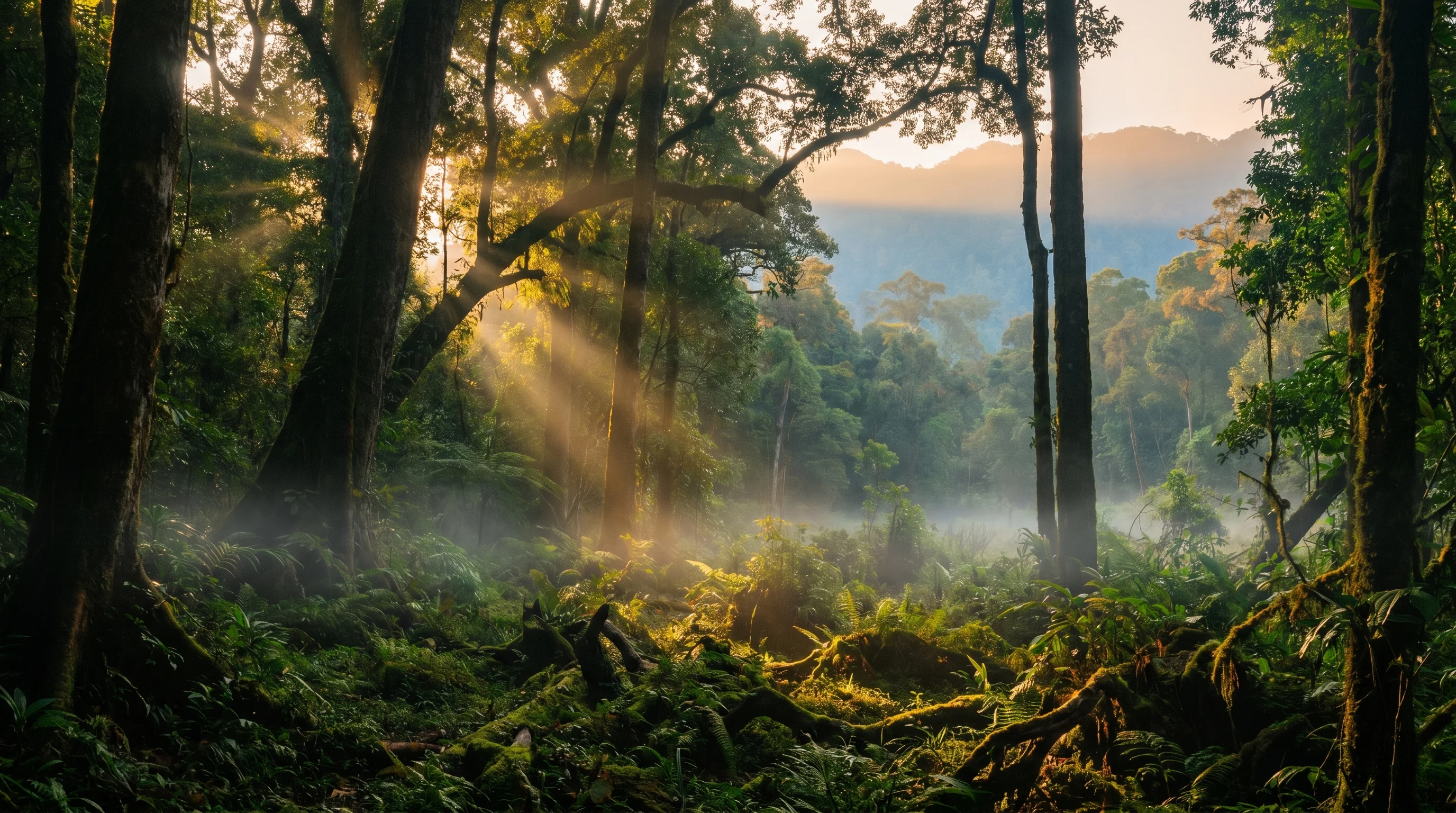
Five things you didn't know about the sumatran tiger.
Cited biology that shapes how the sumatran tiger feeds, defends, survives.
-
Sumatran tigers are the smallest living tiger subspecies, with males maxing out at roughly 140 kg and 2.4 m total length — an adaptation to Sumatra's dense rainforest where smaller body size improves manoeuvrability in tight cover. Source ↗
-
The island-wide population is estimated at fewer than 400 mature individuals across 24 landscape patches, distributed across six main forest complexes in Sumatra. The subpopulation is classified Critically Endangered by the IUCN. Source ↗
-
Under the 2017 Cat Classification Task Force revision (Kitchener et al.), only two tiger subspecies are recognised: continental Panthera tigris tigris and Sunda Panthera tigris sondaica. The Sumatran population is the last surviving Sunda tiger — Javan and Bali populations of the same subspecies went extinct in the 20th century. Source ↗
-
Sumatran tigers prey on Sumatran orangutans (Pongo abelii) infrequently but documented — predation occurs mostly on the ground, where orangutans rarely descend. Orangutan canopy habits and tiger terrestrial hunting patterns create natural separation, but range overlap in the Leuser Ecosystem brings adult tigers into occasional contact with ground-foraging orangutans. Source ↗
-
Sumatran tigers are strong swimmers — camera-trap and field studies across their peat-swamp and riverine habitat show them crossing rivers and pursuing prey through water regularly. Tigers as a genus swim well; Sumatran tigers exploit this more than upland populations because their forest is cut through by large rivers and swamp systems. Source ↗
About the sumatran tiger
Where the sumatran tiger sits on the tree of life.
-
Class
Mammalia
Warm-blooded animals with fur or hair that feed their young milk.
-
Order
Carnivora
Mostly meat-eating mammals — cats, dogs, bears and their relatives.
-
Family
Felidae
The cat family — solitary hunters with retractable claws.
-
Species
Panthera tigris sondaica
Sumatran Tiger — the species this page is about.


Sumatran Tiger
Every fact, cited.
Biology cited on this page comes from peer-reviewed zoology and the major species databases. Click through for the underlying study, dataset or assessment.
- nationalzoo.si.edu · nationalzoo.si.edu
- PLOS · PLOS
- catsg.org · catsg.org
- frontiersin.org · frontiersin.org
- Animal Diversity Web · Animal Diversity Web


